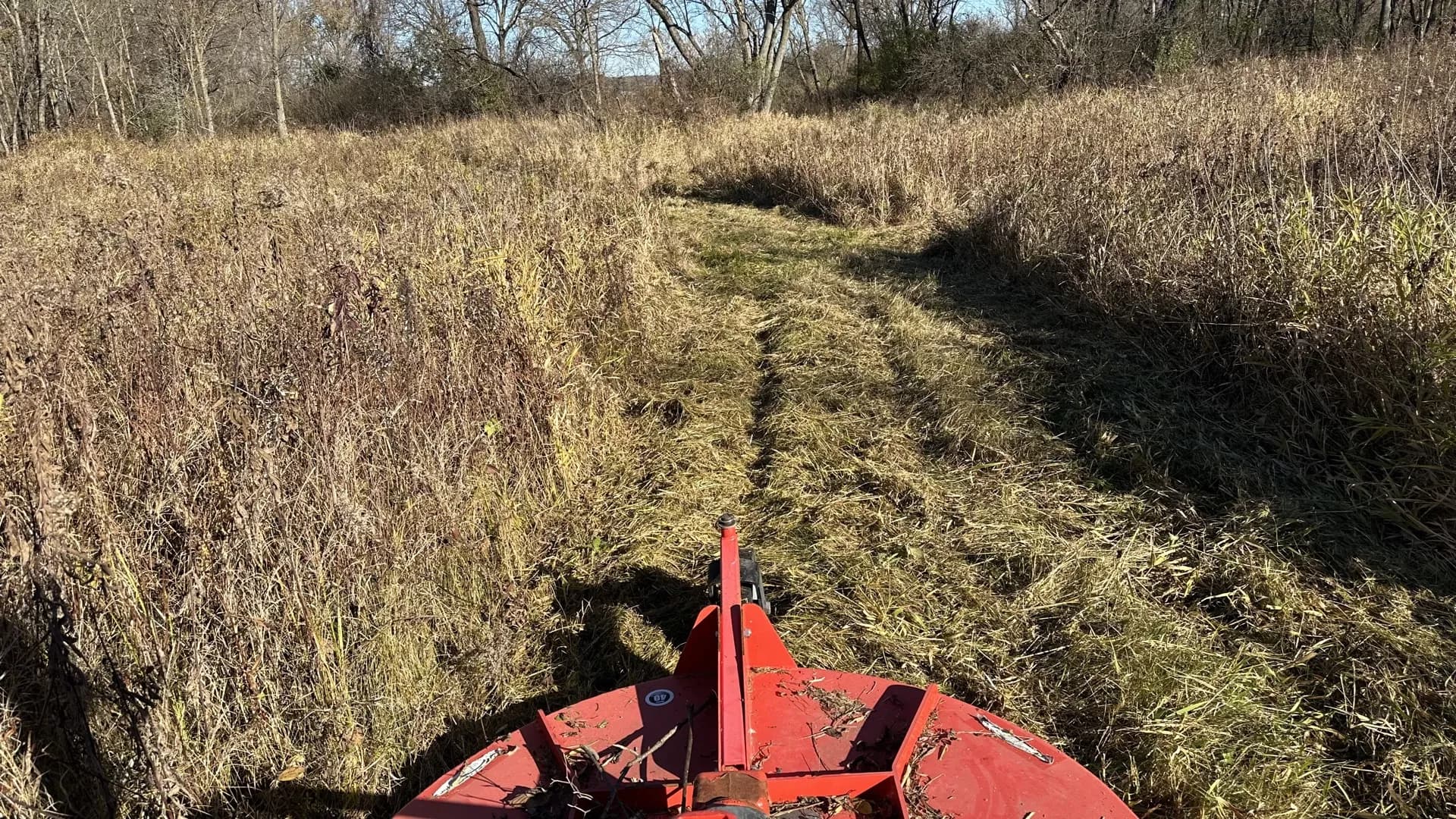
Brush hogging is heavy-duty mowing. A rotary cutter pulled behind a tractor or skid steer chops down tall grass, weeds, saplings, and light brush up to about two inches thick, leaving the cuttings on the ground to break down. In central Wisconsin it usually runs about $150 to $400 per acre for an open, overgrown field, or roughly $75 to $150 an hour, with thicker or hillier ground costing more. It is the cheapest way to knock back a field that has gotten away from you and keep it that way.
Out here around Oxford, we get a lot of calls from folks who let a field, a pasture, or a trail sit a year or two too long. The grass is waist high, the goldenrod and thistle have taken over, and little box elder and prickly ash are starting to come up through it. That is exactly what a brush hog is built for. This is a plain rundown of what brush hogging does, what it costs in our part of Wisconsin, when to schedule it, and how to tell whether you need a brush hog or a heavier machine like a forestry mulcher.
What Is Brush Hogging?
Brush hogging is mowing with a rotary cutter, also called a brush hog or bush hog. It is a thick steel deck with a heavy free-swinging blade underneath, built to cut material a regular lawn mower would choke on. We run it behind a tractor or on a skid steer and drive it across the ground you want knocked down. It shreds tall grass, weeds, briars, brambles, and woody stems up to roughly two inches around, then drops the cut material right where it falls to rot back into the soil.
What it does not do is clear land down to bare dirt or take out real trees. A brush hog cuts at a set height, usually a few inches off the ground, so it mows the top growth but leaves the roots and any stumps in place. Think of it as a reset button for overgrown open ground, not a way to turn woods into a field. For that heavier work you want forestry mulching or land clearing.
What Does Brush Hogging Cost in Central Wisconsin?
Brush hogging is priced one of two ways: by the hour or by the acre. Which one makes sense depends on the parcel. A clean, open field mows fast and gets an acre price. Rough, spotty ground with obstacles and thick patches usually goes by the hour, since the machine spends more time working and turning. Here is what we typically see in our area.
| Condition | What It Looks Like | Typical Cost |
|---|---|---|
| Light field | Tall grass and weeds, mowed regularly, flat and open | $150 to $250 per acre |
| Overgrown field | A year or two of growth, goldenrod, thistle, and small saplings mixed in | $250 to $400 per acre |
| Thick or rough | Heavy brush, hills, wet spots, hidden obstacles, priced by the hour | $75 to $150 per hour |
Those are working ranges to give you a feel for it, not a quote. A few things move the number. How tall and thick the growth is, since a field that has sat three years takes longer than one mowed last summer. How big and open the parcel is, because a wide flat field mows faster per acre than a bunch of small odd-shaped patches. And what is hiding in the grass, since rocks, old fence wire, and stumps slow the work down and are hard on the blade. If your ground is more brush than grass, look at our guide to brush clearing cost in Wisconsin, which covers the heavier jobs.
Brush Hogging vs. Forestry Mulching: Which Do You Need?
This is the question we answer most. Both machines cut vegetation, but they are built for different jobs, and using the wrong one either wastes money or leaves you short. Here is how to tell them apart.
Brush hogging is for maintenance
A brush hog is the right call when the ground is already open and you just need to keep it that way. Grass, weeds, and light brush up to a couple inches. It is fast, it is cheap, and it works great on a field you mow every year or two, a hunting trail, a food plot edge, or a pasture you want to keep from going back to woods. The limit is size. Anything thicker than about two inches or any real trees will stop a brush hog cold or tear it up.
Forestry mulching is for clearing
A forestry mulcher is a different animal. It has a drum with carbide teeth that grinds standing trees, saplings, and thick brush into a mulch layer, roots and stumps included at the surface. It clears ground a brush hog cannot touch, turning brush and small woods into open, usable land in one pass. It costs more per acre because it is doing far more work. If your field has grown up into a thicket of buckthorn, prickly ash, and young box elder taller than you, that is a mulching job, not a mowing job. Our post on forestry mulching versus traditional clearing goes deeper on the heavy end.
The simple test: if you can still walk through it and it is mostly grass and weeds with a few small saplings, brush hog it. If it has closed in and turned woody, mulch it. When we come look at your property we will tell you straight which one your ground needs, and sometimes the answer is mulch it once to reset it, then brush hog it every year after to keep it open.
When Should You Brush Hog in Wisconsin?
Timing matters more than people think. Mow at the wrong time and you either miss the point or make more work for yourself. Here is how the season plays out in central Wisconsin.
- Late spring to early summer. Once the ground firms up and the growth is up but before it goes to seed, an early mow knocks back weeds and thistle before they spread. This is a good first pass on a field you plan to keep open.
- Mid to late summer. A midsummer cut catches the heavy growth at its peak and sets the field up clean for fall. If you only brush hog once a year, this window is usually the most bang for your buck.
- Fall. A fall mow leaves the field short heading into winter, which makes for cleaner spring green-up and easier walking during hunting season. Fall is also when we do a lot of trail and food plot edge work before the season opens.
Avoid mowing right after heavy rain on our low, sandy ground, since a loaded tractor will rut a soft field. And if you are managing for wildlife or ground-nesting birds, hold off until after nesting season, usually past mid-July, so you are not mowing over nests. For more on seasonal timing across all our land work, see our guide to the best time to clear land in Wisconsin.
What Do People Use Brush Hogging For?
Around here the same handful of jobs come up again and again. If any of these sound like your property, a brush hog is probably what you need.
- Overgrown fields and old pasture. The most common call. A field that has sat a couple years and needs to be reclaimed as open ground before it turns to brush.
- Hunting trails and shooting lanes. Keeping trails walkable and lanes clear through the fall. This ties in with our food plot and hunting land work.
- Food plot prep and edges. Knocking down growth before planting and keeping the edges of a plot from closing in.
- Fence lines and field edges. Mowing back the strip along a fence or the edge of a field before it goes woody, which pairs with our field edge trimming service.
- Vacant lots and acreage. Keeping a parcel mowed and presentable, whether it is between uses or you just do not want it growing up.
Where We Offer Brush Hogging
We run our brush hogging service across our eight-county area from our base in Oxford, covering Marquette, Adams, Waushara, Juneau, Columbia, Sauk, Green Lake, and Portage counties. That includes Montello, Westfield, Packwaukee, Neshkoro, Endeavor, Wautoma, Portage, Baraboo, and the smaller towns in between. A lot of the ground out here is old field and light woods edge that wants mowing every year or two to stay open, and we set up plenty of folks on a regular schedule so their fields never get away from them again.
Whether it is a single overgrown acre behind the house or forty acres of old pasture you are reclaiming, we will come look, tell you honestly whether it is a mowing job or a clearing job, and give you a straight price.
Get a Free Brush Hogging Estimate
If you have a field, trail, or pasture that needs knocked back, we can mow it and set you up to keep it open. Call (608) 292-3934 or request your free estimate online, and we will look at your ground, figure out whether it needs a brush hog or a mulcher, and give you one honest price.
Last updated: July 2026
Frequently Asked Questions About Brush Hogging
How much does brush hogging cost in Wisconsin?
In central Wisconsin, brush hogging usually runs about $150 to $250 per acre for a light, open field, $250 to $400 per acre for an overgrown field with a year or two of growth, or roughly $75 to $150 an hour for thick, hilly, or obstacle-filled ground that gets priced by time. The main factors are how tall and thick the growth is, how big and open the parcel is, and what is hiding in the grass. We give one honest price after a free on-site look.
What is the difference between brush hogging and forestry mulching?
Brush hogging is heavy mowing. A rotary cutter chops down grass, weeds, and light brush up to about two inches thick and leaves the roots and stumps in place, so it is for maintaining open ground. Forestry mulching uses a drum with carbide teeth to grind standing trees, saplings, and thick brush into a mulch layer, so it clears ground a brush hog cannot touch. Use a brush hog to keep an open field open, and a mulcher to turn brush or small woods into usable land.
How thick of brush can a brush hog cut?
A brush hog will cut grass, weeds, briars, saplings, and woody stems up to roughly two inches around. Anything thicker than that, or any real tree, will either stop the machine or damage the blade and deck. If your ground has grown up into brush and small trees taller than you, that is a forestry mulching job rather than a mowing job.
When is the best time to brush hog a field in Wisconsin?
Mid to late summer is usually the best single time to brush hog, since it catches the heavy growth at its peak and sets the field up clean for fall. An early-summer pass helps knock back weeds and thistle before they seed, and a fall mow leaves the field short for winter and clean for hunting season. Avoid mowing right after heavy rain on soft ground, and if you are managing for wildlife, wait until after ground-nesting season in mid-July.
Does brush hogging remove stumps or roots?
No. A brush hog cuts at a set height a few inches off the ground, so it mows the top growth but leaves the roots and any stumps in place. It is a mowing tool, not a clearing tool. If you want stumps gone and the ground opened up, you need stump grinding or land clearing rather than brush hogging.
Do you offer brush hogging near me in central Wisconsin?
Yes. We offer brush hogging across our eight-county area from our base in Oxford, including Montello, Westfield, Packwaukee, Neshkoro, Endeavor, Wautoma, Portage, and Baraboo, covering Marquette, Adams, Waushara, Juneau, Columbia, Sauk, Green Lake, and Portage counties. We also set customers up on a regular mowing schedule. Call (608) 292-3934 or request a free estimate online.