Forestry mulching uses one machine to grind trees and brush into mulch in a single pass — at a fraction of the cost of traditional methods. Traditional clearing requires multiple machines, a crew, and hauling, running $3,000+ per acre industry-wide. For most land clearing projects in central Wisconsin, forestry mulching is faster, cheaper, and better for the soil. But traditional clearing still has its place for large timber and full site prep.
We get asked about this comparison on nearly every job. Landowners have heard of forestry mulching but are not sure how it stacks up against the chainsaw-and-bulldozer approach they have seen before. Here is the honest breakdown from our experience clearing land across Marquette, Adams, Sauk, and Columbia counties.
How Does Forestry Mulching Work?
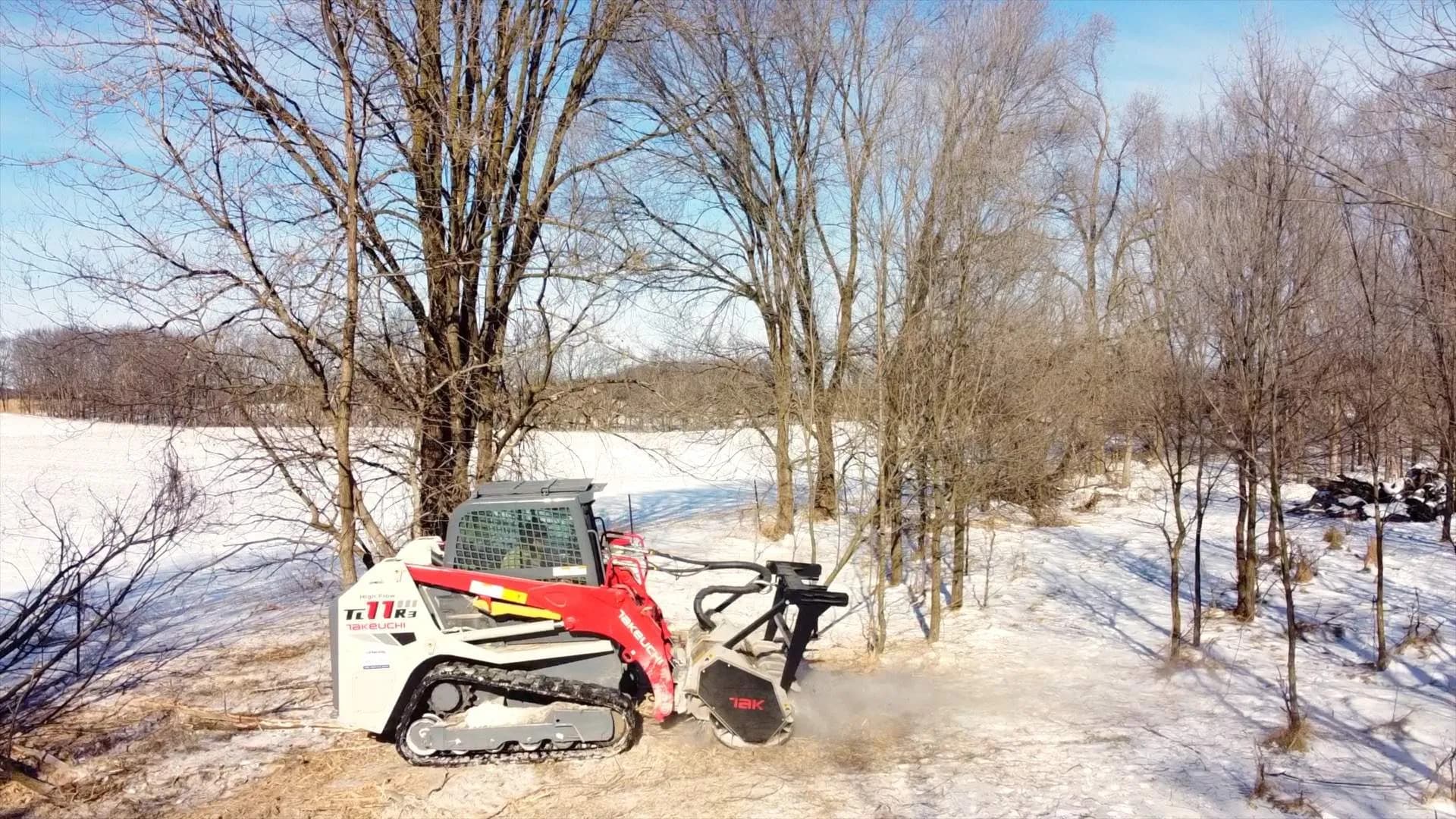
A forestry mulcher is a machine with a high-speed rotating drum covered in carbide-tipped teeth. It mounts on a skid steer or compact track loader. The operator drives through vegetation, and the drum grinds everything in its path into small wood chips. Trees up to 6 to 8 inches in diameter, brush, saplings, and vines all get processed in one pass.
The mulched material falls to the ground as a 2 to 4 inch layer of wood chips. One machine, one operator, one pass for most vegetation. Larger trees that exceed the mulcher's capacity are felled with a chainsaw first and hauled off-site before the mulcher processes the remaining brush, stumps, and smaller growth.
How Does Traditional Land Clearing Work?
Traditional clearing is a multi-step process that typically involves:
- Chainsaw crew: 2 to 4 workers fell trees and buck them into manageable lengths
- Skidder or loader: Drags logs to a landing area
- Chipper or grinder: Processes brush and small material
- Dump trucks: Haul chips, logs, and debris off-site
- Stump grinder: Comes through after to grind stumps (optional)
- Bulldozer: Pushes remaining debris, levels the site (if needed)
That is 3 to 6 pieces of equipment and a crew of 4 to 8 people working over several days to a couple of weeks for a typical 5-acre project.
Side-by-Side Comparison
Here is a detailed comparison across the factors that matter most to Wisconsin landowners.
| Factor | Forestry Mulching | Traditional Clearing |
|---|---|---|
| Cost per acre | Free estimate | $3,000+ |
| Equipment needed | 1 machine | 3 - 6 machines |
| Crew size | 1 operator | 4 - 8 workers |
| Time per acre | 4 - 8 hours | 2 - 5 days |
| Max tree diameter | 6 - 8" (single pass) | No limit |
| Debris disposal | Stays on-site as mulch | Hauled off-site |
| Topsoil impact | Minimal disturbance | Moderate to heavy |
| Erosion protection | Excellent (mulch layer) | Poor (bare ground) |
| Stump treatment | Ground to grade | Separate grinding step |
| Site ready for planting | Yes, immediately | Needs cleanup first |
When Forestry Mulching Is the Better Choice
Forestry mulching wins in the majority of clearing situations we see in central Wisconsin. Here are the projects where it makes the most sense:
- Food plot clearing: Mulching leaves a clean, plantable surface with no stumps or debris to work around. The mulch layer breaks down and adds organic matter to the soil.
- Building lot clearing: Clear a home site or cabin site quickly without the mess and cost of a full crew.
- Brush and overgrowth removal: Reclaim pastures, clear fence lines, or open up overgrown areas where trees are under 8 inches.
- Invasive species removal: Knock back buckthorn, honeysuckle, and autumn olive across large areas in a fraction of the time it takes by hand.
- Hunting property management: Create trails, shooting lanes, and open areas while preserving the trees you want to keep.
- Any project where topsoil matters: If you plan to plant grass, crops, or food plots, the preserved topsoil and mulch layer give you a huge head start.
When Traditional Clearing Is the Better Choice
Traditional clearing still makes sense in specific situations:
- Large timber harvest: If you have mature trees worth money as lumber, you want a logger to harvest them, not grind them up. Trees over 14 inches in diameter with straight trunks may have timber value.
- Full site grading: If you need the ground scraped, leveled, and graded for a building foundation, you need an excavator regardless. Mulching can handle the vegetation first, but the grading requires heavy iron.
- Very large trees: Trees over 14 inches in diameter are too big for the mulcher. These need to be felled first. We often do a combination approach: fell the big stuff, then mulch everything else.
- Clean ground requirement: Some projects require bare mineral soil with no organic material. Traditional clearing followed by grading achieves this. Mulching leaves a chip layer.
Real Cost Comparison: 5-Acre Project in Central Wisconsin
Let us put real numbers to a typical project. Say you own 5 acres of overgrown land near Westfield with dense brush and scattered trees up to 6 inches in diameter. You want it cleared for a future building site and food plots.
Forestry Mulching Estimate
- Mobilization: Included in flat rate
- 5 acres of medium density: Varies by property — get a free estimate
- Hauling: $0 (material stays on-site)
- Stump grinding: $0 (included)
- Timeline: 2 to 3 days
- Total: Contact us for a flat-rate project quote
Traditional Clearing Estimate (Industry Average)
- Chainsaw crew (3 days): ~$3,200
- Skidder rental: ~$1,800
- Chipper and disposal: ~$2,400
- Dump truck loads (6 loads): ~$2,100
- Stump grinding: ~$1,000
- Timeline: 7 to 10 days
- Total: approximately $10,500
Forestry mulching costs a fraction of traditional clearing for the same end result. The mulched site is also ready for planting sooner because the mulch layer is already in place protecting the soil. Request a free estimate to see the difference on your property.
The Combination Approach
Many of our projects in the Baraboo and Wisconsin Dells area involve mixed timber. You might have 8-inch oaks scattered among dense brush and invasive shrubs. In these cases, we use a combination approach:
- Fell the larger trees (over 8 inches) with a chainsaw
- Stack the logs for the landowner to use as firewood or have hauled for lumber
- Run the mulcher through everything else: brush, stumps, slash, and understory
This gives you the efficiency of mulching for the bulk of the work while handling the big trees properly. Cost depends on the number of large trees and overall density — contact us for a free estimate.
Which Method Should You Choose?
For 90 percent of the land clearing projects we see in central Wisconsin, forestry mulching is the right answer. It is faster, cheaper, better for the soil, and leaves the site ready to use immediately.
The 10 percent where traditional clearing makes more sense involves large timber, full site grading, or situations where you need completely bare ground.
Not sure which approach fits your project? Request a free on-site estimate and we will walk your property with you and recommend the best approach. We serve Oxford, Portage, Baraboo, Wisconsin Dells, and all of central Wisconsin. Call (608) 292-3934.
Last updated: March 2026
Frequently Asked Questions
Is forestry mulching better than traditional clearing?
For most projects involving brush and trees under 8 inches in diameter, forestry mulching is better. It costs 60 to 80 percent less, finishes in a fraction of the time, preserves topsoil, and leaves a protective mulch layer. Traditional clearing is better only for large timber harvest or projects requiring full site grading.
Can forestry mulching handle large trees?
Forestry mulchers handle trees up to 6 to 8 inches in diameter in a single pass. For larger trees up to 14 inches, we fell them with a chainsaw first and then mulch the stumps and brush. Trees over 14 inches should be harvested for timber or removed with traditional equipment before mulching the remaining vegetation.
What happens to the mulch after forestry mulching?
The wood chip mulch left by forestry mulching breaks down naturally over one to two growing seasons. During that time, it suppresses weed growth, prevents erosion, retains soil moisture, and adds organic matter to the soil as it decomposes. Most landowners find this beneficial, especially if planting food plots or grass.
How fast is forestry mulching compared to traditional clearing?
Forestry mulching typically clears 1 acre in 4 to 8 hours depending on vegetation density. Traditional clearing takes 2 to 5 days per acre when you account for felling, skidding, chipping, hauling, and stump grinding. For a 5-acre project, mulching takes 2 to 3 days total while traditional clearing takes 1 to 2 weeks.