Forestry mulching is a one-machine, one-operator land clearing method that grinds standing trees, brush, and stumps into a layer of wood chip mulch right on the ground. We run a forestry mulching operation out of Oxford, WI and work across eight central Wisconsin counties. This page covers what the work looks like, where we go, and what it costs.
Where We Work in Central Wisconsin
Our base is in Marquette County, a half mile off Highway 82. From there we run jobs across Marquette, Adams, Waushara, Portage, Juneau, Columbia, Sauk, and Green Lake counties. The 50-mile radius covers most of the Central Sands, the eastern edge of the Driftless, and a stretch of the Wisconsin River corridor.
Most of our calls come from these areas:
- Marquette County: Oxford, Montello, Packwaukee, Endeavor, Westfield, Neshkoro
- Adams County: Adams/Friendship, Big Flats, Coloma, Strongs Prairie
- Sauk County: Baraboo, Reedsburg, Wisconsin Dells (south side), Loganville
- Columbia County: Portage, Pardeeville, Wyocena, Briggsville
- Waushara County: Wautoma, Plainfield, Hancock, Redgranite
- Portage County: Stevens Point, Plover, Almond, Amherst
If you are outside that ring but close to it, call. We have driven to Beaver Dam, Ripon, and the south side of Stevens Point on jobs that made sense.
What Forestry Mulching Does on a Wisconsin Property
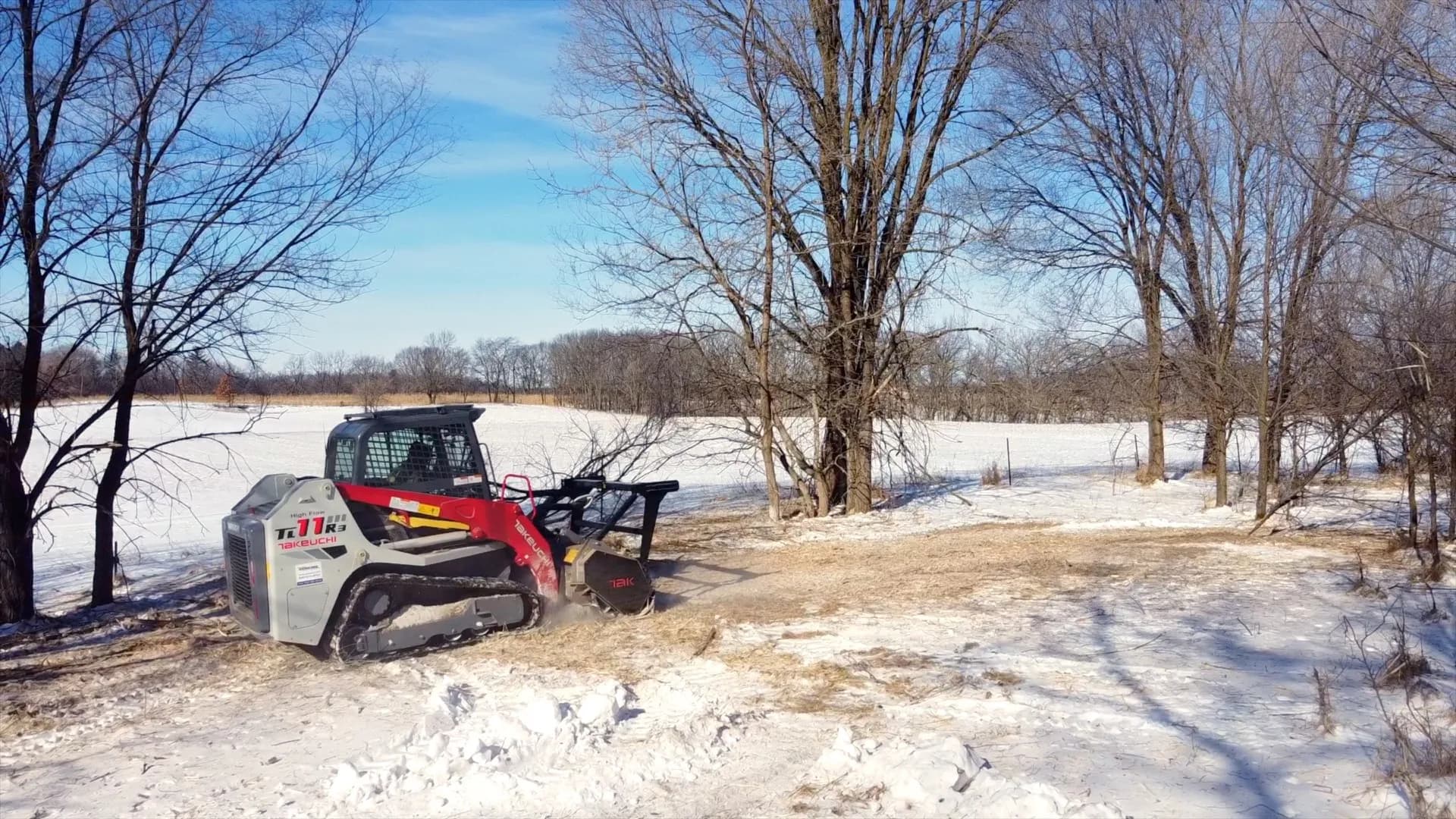
The machine is a compact track loader with a high-flow mulching head. The head spins a drum at around 2,000 RPM with carbide teeth that chew trees, brush, stumps, and saplings into chips on contact. One pass turns standing vegetation into a layer of wood mulch on the ground. No piles to burn, no debris to haul.
On a Central Wisconsin property, that usually means one of these:
- Hunting land work: shooting lanes, food plot prep, trail clearing, bedding edges. See our food plot service.
- Lot clearing for a house, cabin, or shop: opening up a building site without bulldozing the topsoil off.
- Pasture and field reclamation: taking back ground that has grown up in box elder, prickly ash, and buckthorn since the last time it was mowed.
- Fence line and property line clearing: opening 10 to 30 feet wide along fence rows so you can run woven wire or hi-tensile.
- Invasive species removal: buckthorn, autumn olive, Japanese barberry, honeysuckle. Wisconsin DNR rule NR 40 lists these as restricted or prohibited.
- Trail systems: ATV trails, hunting access, fire breaks, walking paths.
Wisconsin-Specific Factors That Affect the Work
Central Sands soils
The sandy soils across Oxford, Wautoma, Adams, and the Plover Hi-Capacity area are about as good as it gets for mulching. The ground stays firm under the machine, drainage is fast, and the mulch breaks down in one to two seasons because the soil biology is active. Less rutting, less compaction, faster decomposition.
Driftless terrain
The Driftless side of our service area, including Baraboo, Reedsburg, and parts of Sauk County, is hillier and rockier. The machine still works, but we slow down. Steep slopes get worked along the contour. Rock outcrops get marked and avoided so we do not trash teeth.
Frozen ground
December through early March is one of our busiest seasons. Frozen ground supports the machine with zero rutting, leaves are off so sight lines are clear, and the mulch lays cleaner. If your project is not urgent, ask about winter scheduling.
Wetlands and DNR setbacks
If your property has a creek, pond, marsh, or anything mapped on the Wisconsin Wetland Inventory, there are setback rules. We have run jobs that needed a notification or a buffer, and we will tell you up front if your project triggers anything. We are not going to push you into a violation.
NR 40 invasives
Buckthorn, honeysuckle, autumn olive, and a few others are on the Wisconsin DNR NR 40 list. Mulching them in spring can spread seed. We usually time those jobs for late summer through winter to keep the seed bank from getting worse. Follow-up spray on the cut stumps the same season is often part of the plan.
What It Costs in Central Wisconsin
Forestry mulching in central Wisconsin runs roughly $600 to $1,200 per acre on typical jobs. Light brush on flat sandy ground can come in at $400 to $600. Dense hardwood stands on steep terrain can run $1,500+ per acre. Single-acre and partial-acre jobs are quoted as a flat project price because mobilization is a fixed cost. See our full cost breakdown for more detail.
What moves the price up or down:
- Vegetation density and tree size: a thick stand of 6-inch box elder eats more time than knee-high prickly ash.
- Terrain and rock: flat sand is fast; steep, rocky ground is slow.
- Access: if we can drive the machine to the work area, great. If we have to cut an access path first, that is part of the quote.
- Total acreage: bigger jobs get a better per-acre rate because we are not absorbing mobilization on every acre.
We quote everything as a flat project price. You see the number before any equipment shows up.
How a Typical Job Runs
- Free on-site estimate. Adam walks the property with you, looks at access, vegetation, terrain, and any factors that change the quote. You get a flat written price within 24 to 48 hours.
- Scheduling. We book in date order. Lead time is usually 2 to 6 weeks depending on the season. Winter often books faster than summer.
- Day of the work. Adam runs the machine. We start where you want us to start. Most one-acre jobs are done in a day; bigger projects run multi-day.
- Walkthrough. Before we leave, we walk the cleared area with you. If anything was missed, we fix it before we load up.
- Payment. Flat price, due on completion. Check, ACH, or card.
When Forestry Mulching Is Not the Right Tool
Skip mulching if you need:
- Full site grading. If you need a flat building pad, you still need an excavator or dozer after mulching.
- Salvage timber. If you have mature oak or walnut worth selling, talk to a forester first. Mulching destroys saw log value.
- Deep root removal for utilities. Mulching grinds to grade. If you need a clean trench for water or electric, separate excavation is needed.
- Wetland clearing. Most mapped wetlands cannot be cleared without permits. Different conversation entirely.
For everything else, including brush, saplings, small to medium hardwoods, stumps, invasives, food plots, fence lines, and trail systems, mulching is usually the right call.
Get a Free Estimate
If you have a property in central Wisconsin that needs clearing, call (608) 292-3934 or request a free estimate online. Adam will walk your property and give you a flat written price. No surprise add-ons, no fuel surcharges, no pressure.
Last updated: April 2026
Frequently Asked Questions
What does forestry mulching cost per acre in Wisconsin?
Most central Wisconsin jobs land between $600 and $1,200 per acre. Light brush on flat sandy ground can come in lower. Dense hardwoods on steep ground run higher. We quote a flat project price after a free on-site visit so you know the number before we start.
What size trees can a forestry mulcher handle?
Up to about 8 inches in diameter in a single pass. Trees in the 10 to 14 inch range get cut with a chainsaw first, then the mulcher processes the stumps and slash. Trees over 14 inches are usually cleared separately or felled and left if you want them for firewood.
Do you serve my county in central Wisconsin?
We work across Marquette, Adams, Waushara, Portage, Juneau, Columbia, Sauk, and Green Lake counties from our base in Oxford, WI. If you are within roughly 50 miles of Oxford, the answer is almost always yes. Call and we will tell you for sure.
Is forestry mulching better than bulldozing?
For most clearing jobs in Wisconsin, yes. Mulching keeps the topsoil intact, leaves a mulch layer that protects against erosion, costs less, and finishes faster. Bulldozing is the right call when you need full site grading or are stripping a building pad. For everything else, mulching wins.
Can you forestry mulch in winter in Wisconsin?
Yes, and winter is one of the best times. Frozen ground means zero rutting, the leaves are off the trees so the operator has clear sight lines, and the work goes clean. We run the machine December through March most years.
Does forestry mulching kill invasive species like buckthorn?
It removes the standing vegetation. To actually kill the root system, the cut stumps need a follow-up herbicide application within a few hours of cutting. That is standard practice for buckthorn, honeysuckle, and autumn olive. We can do that work or coordinate with whoever handles your spray.
How long does it take to mulch one acre?
Light brush: 2 to 4 hours. Medium vegetation with saplings up to 5 inches: 4 to 8 hours. Heavy hardwood brush up to 8 inches: 6 to 12 hours. Add time for steep terrain, rock, or large trees that need felling first. We give you a timeline with the estimate.
Do I need a permit for forestry mulching in Wisconsin?
For most private property clearing, no. If you are within wetland setbacks, working near a navigable waterway, or clearing volume that triggers timber harvest reporting, the answer changes. We will flag any of that during the estimate so you know before you commit.