Forestry mulching cost per acre in Wisconsin ranges widely based on vegetation density, terrain, tree size, and accessibility. Light brush on flat, sandy ground clears fastest and costs the least per acre. Heavy hardwood stands on steep Driftless Area bluffs take the most time and cost the most. We provide free on-site estimates with flat pricing — no hourly billing, no surprises.
We run a forestry mulching operation out of Oxford, WI and clear land across eight counties in central Wisconsin. Pricing is the number one question we get, so here is a straight breakdown of what drives cost and how to get an accurate number for your property.
What Does Forestry Mulching Cost Per Acre?
The honest answer is: it depends on what is growing on your land. A flat acre of light brush on sandy ground clears in a fraction of the time it takes to process a dense stand of 8-inch hardwoods on a hillside. Here is how vegetation density affects cost and timeline.
| Vegetation Level | What It Looks Like | Time Per Acre | Relative Cost |
|---|---|---|---|
| Light | Grass, weeds, scattered saplings under 2 inches. Old field regrowth, CRP ground. | 2 - 4 hours | Lowest |
| Medium | Dense brush, saplings 2 to 5 inches, scattered larger trees. Typical hunting land. | 4 - 8 hours | Moderate |
| Heavy | Thick stands of 4 to 8 inch trees, dense understory, vines. Neglected timber. | 6 - 12 hours | Higher |
| Heavy + Large Trees | Mixed timber with trees over 8 inches. Requires felling before mulching. | 1 - 2+ days | Highest |
The ranges above assume flat to gently rolling terrain. Steep slopes, rocky ground, or limited access add time and cost. Request a free on-site estimate for accurate pricing on your specific property.
Forestry Mulching vs. Other Clearing Methods: Cost Comparison
Forestry mulching is not the only way to clear land, but it is the most cost-effective option for the majority of residential and recreational projects. Here is how the main methods compare.
| Factor | Forestry Mulching | Bulldozer / Excavation | Manual (Chainsaw + Chipper) |
|---|---|---|---|
| Cost per acre | Get a free estimate | $3,000 - $6,000+ (industry avg.) | $4,000 - $8,000+ (industry avg.) |
| Timeline per acre | 4 - 12 hours | 1 - 3 days | 1 - 2 weeks |
| Crew size | 1 operator, 1 machine | 2 - 4 people, multiple machines | 3 - 5 person crew |
| Debris disposal | Stays on-site as mulch | Hauled off — dump fees apply | Hauled off or burned |
| Stump handling | Ground to grade in same pass | Pulled or pushed — leaves holes | Separate stump grinding needed |
| Soil disturbance | Minimal — topsoil stays intact | Significant — bare dirt, ruts | Moderate — foot traffic and equipment |
| Erosion protection | Mulch layer prevents erosion | High erosion risk — exposed soil | Moderate — some debris remains |
| Best for | Brush, saplings, trees up to 8" | Heavy timber, full site grading | Selective removal, tight spaces |
For a deeper comparison of all land clearing costs in Wisconsin, see our complete cost breakdown.
What Factors Affect Forestry Mulching Cost?
No two properties are the same. Here are the specific factors that move the price up or down on a forestry mulching project.
Vegetation Density and Type
This is the single biggest cost driver. An acre of light brush — grass, weeds, and saplings under 2 inches — clears in a few hours. An acre of dense hardwood with 6 to 8 inch oaks and thick understory takes three to four times as long. Softwood species like pine and aspen process faster than hardwoods like oak and hickory because the wood is less dense and the machine can maintain higher speed.
Tree Diameter
Our mulching head handles trees up to about 6 to 8 inches in diameter in a single pass. Trees in the 8 to 12 inch range can still be mulched but take significantly more time per stem. Trees over 12 inches typically need to be felled with a chainsaw first, then the mulcher processes the stumps and slash. If your property has a lot of large-diameter timber, the combined fell-and-mulch approach adds time and cost compared to a property with only brush and small trees.
Terrain and Soil Type
Flat ground clears faster than slopes. The sandy, flat terrain in the Central Sands region around Oxford, Adams, and Marquette County is the easiest and cheapest to work. The equipment moves fast, the sand provides a firm base, and there are rarely any surprises underground.
Compare that to the Driftless Area around Baraboo and Reedsburg, where you have steep bluffs, clay soils, and rocky outcrops. The machine works slower on slopes, the operator needs more care to avoid stability issues, and clay soil can turn to mud after rain. Driftless Area projects typically cost 15 to 25 percent more than equivalent work on Central Sands ground.
Accessibility
If we can drive the machine directly from the road or a field edge to the work area, we start clearing right away. If the work site is deep in the woods with no existing access, we need to cut a path in first — that is extra machine time that adds to the total. Properties with narrow gates, low-clearance bridges, or long soft driveways can also add mobilization time.
Project Size
Bigger projects cost less per acre. Here is why: mobilization is a fixed cost. Loading the mulcher onto the trailer, driving to your site, unloading, setting up, and the return trip home — that takes the same amount of time whether we are clearing half an acre or 20 acres. On a small job, mobilization is a meaningful share of the total. On a large job, it barely registers.
- Under 1 acre: Highest per-acre rate — mobilization is a large share of total cost
- 1 to 5 acres: Per-acre cost starts dropping as fixed costs spread out
- 5 to 20 acres: Good value — multi-day projects with efficient scheduling
- 20+ acres: Best per-acre rate — large projects get our most competitive pricing
If you have a large project, request an estimate — we can often offer better rates on bigger jobs and flexible scheduling. See our pricing page for more details.
Wisconsin-Specific Cost Factors
Wisconsin has conditions that affect forestry mulching costs differently than other states.
Central Sands sandy soil: The sandy ground in Adams, Marquette, and Waushara counties drains fast and stays firm under heavy equipment. We can work nearly year-round on sandy soil without rutting your property. This is our cheapest area to operate.
Driftless Area bluffs: The unglaciated hills around Baraboo, Reedsburg, and western Sauk County have steep slopes, clay soils, and more exposed rock. Equipment works slower, access is harder, and the dense hardwood takes more machine time. Budget 15 to 25 percent more for Driftless Area projects.
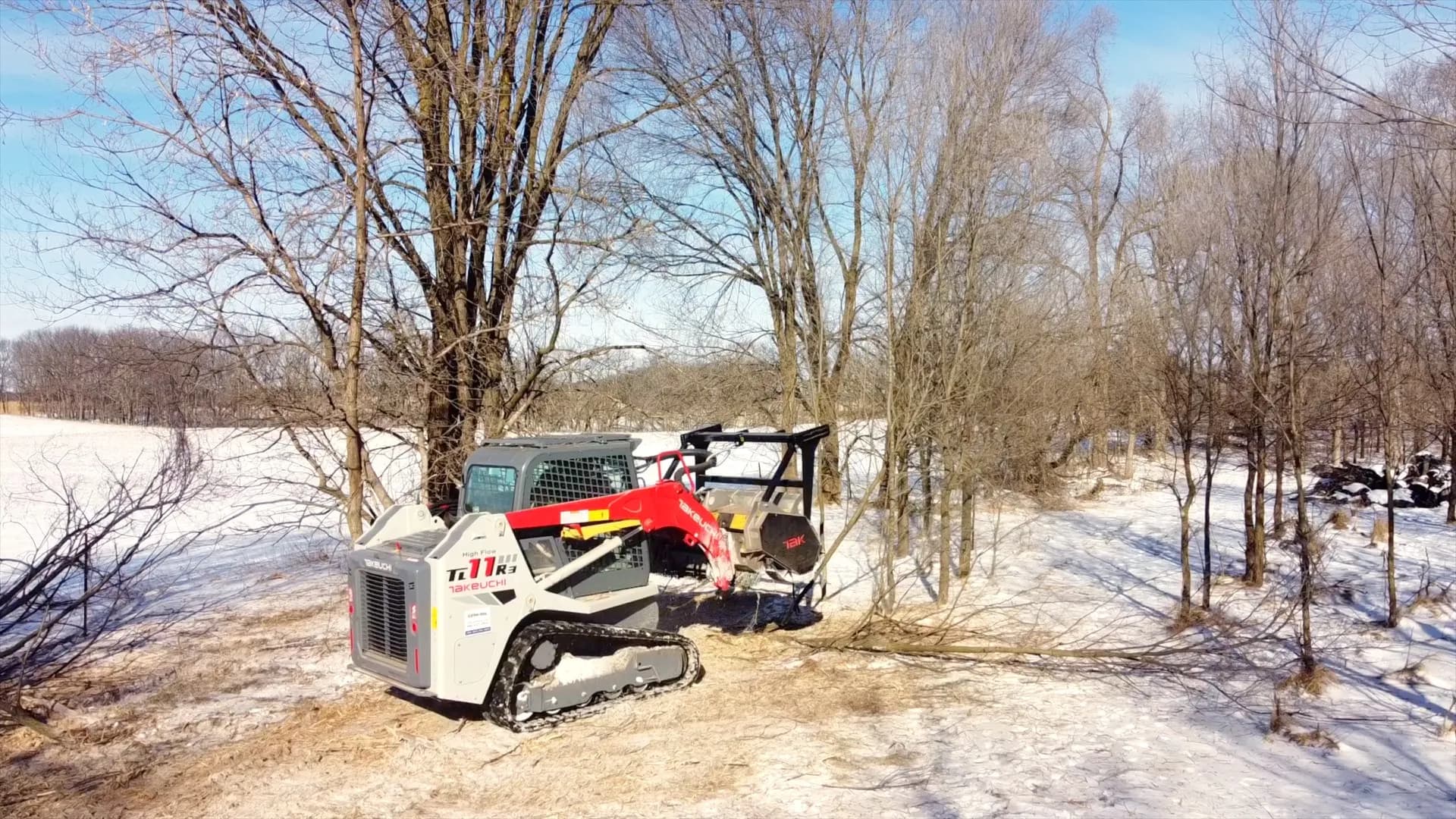
Frozen ground advantage: December through February, frozen ground is ideal for mulching. The machine floats on hard-frozen soil, we can access low areas that stay soft the rest of the year, and there is zero risk of rutting. If your schedule is flexible, winter projects often come with faster scheduling since demand dips.
Spring mud season: March through early May can be tricky. Spring thaw turns clay soils into mud and even sandy soils can be soft after snow melt. We will be honest with you if waiting two weeks will give you a better result and protect your property from unnecessary damage.
Common Forestry Mulching Projects and What They Cost
Most of our work falls into a few common project types. Here is what each involves.
Food Plot Clearing for Deer Hunters
This is one of our most common calls. A typical food plot project involves clearing 1 to 3 plots of half an acre to 2 acres each, plus cutting shooting lanes and travel corridors between plots and stand locations. The mulch layer that forestry mulching leaves behind actually benefits the soil — it breaks down over a season and adds organic matter before you plant. Most food plot projects are one- to two-day jobs depending on total area and vegetation density.
Lot Clearing for Construction
Lot clearing for a pole barn, home site, or cabin typically involves 1 to 3 acres. We clear the vegetation, grind stumps to grade, and leave the site ready for your builder or excavator. Cost depends on vegetation density — a lot covered in light brush and saplings clears fast, while one full of mature hardwoods takes more time. Most lot clearing jobs in the Central Sands are one-day projects.
Fence Line Clearing
Fence line work is priced by corridor length and width rather than acreage. A standard clearing runs 10 to 15 feet on each side of the fence. Light brush along a fence row clears quickly, while heavily overgrown fence lines with dense hardwoods take more time per linear foot.
Full Acreage Clearing (5 - 20+ Acres)
Large-scale projects are where the per-acre savings really add up. A 10- or 20-acre job spreads mobilization over enough area that per-acre cost drops significantly. We typically schedule larger projects for winter when frozen ground conditions are optimal. If you are clearing for agricultural conversion, full land clearing, or large-scale habitat work, contact us for an estimate on your project.
How to Save Money on Forestry Mulching
A few practical ways to keep your mulching project cost down:
- Schedule for winter. Frozen ground means faster production and less risk. We may have more scheduling flexibility December through February.
- Clear more at once. Per-acre cost drops as project size increases. If you are going to clear 5 acres eventually, do it all at once instead of one acre per year.
- Remove large trees yourself first. If you have the equipment and skills to fell and remove trees over 12 inches before we arrive, we can focus the mulcher on brush and stumps — which is faster and cheaper.
- Be flexible on timing. If you can wait for the right ground conditions rather than needing an exact date, we can schedule your project when conditions are ideal for production speed.
- Combine with neighbors. If a neighbor also needs clearing, we can do both properties in the same trip and split the mobilization cost.
What Is Included in Our Pricing
When we give you a price, that is the price. Here is what is included:
- Free on-site estimate — Adam walks your property personally
- Flat-rate project pricing — not hourly, not day-rate
- All equipment mobilization (loading, transport, unloading)
- Mulching of all brush, saplings, and trees within the mulcher's capacity
- Stump grinding to grade on all mulched trees
- Mulch left on-site as ground cover (no hauling needed for mulched material)
- No hidden fees, no fuel surcharges, no surprise add-ons
The only thing not included is removal of large trees that exceed the mulcher's capacity. If your property has trees over 12 inches that need felling and hauling, we will include that as a separate line item in your estimate so there are no surprises.
How to Get a Free Estimate
The best way to get an accurate forestry mulching price is a free on-site visit. Adam walks every property personally and looks at vegetation density, tree size, terrain, access, and any site-specific factors. You get a flat written price before any equipment moves.
We serve all of central Wisconsin including Oxford, Montello, Baraboo, Wisconsin Dells, Portage, Wautoma, Adams, Stevens Point, and the surrounding counties.
Call (608) 292-3934 or request your free estimate online.
Last updated: March 2026
Frequently Asked Questions About Forestry Mulching Costs
How much does forestry mulching cost per acre?
Forestry mulching cost per acre depends on vegetation density, terrain, tree size, and accessibility. Light brush on flat sandy ground costs the least per acre and clears in 2 to 4 hours. Dense hardwood stands with steep terrain cost the most and can take a full day or more per acre. Request a free on-site estimate for accurate pricing on your property.
Is forestry mulching cheaper than bulldozing?
Yes. Forestry mulching is significantly cheaper than bulldozing for most clearing projects. Bulldozing and excavation typically cost $3,000 to $6,000+ per acre at industry average rates, require multiple machines and crew members, and incur hauling and dump fees for debris. Forestry mulching uses one machine, one operator, and leaves mulch on-site — eliminating most of the costs that make excavation expensive.
How much does it cost to mulch 5 acres?
A 5-acre mulching project benefits from significant per-acre savings because mobilization cost is spread over more area. The total cost depends on vegetation density and terrain. A 5-acre project in the Central Sands with moderate brush is typically a one- to two-day job. Contact us for a free estimate — we will walk your property and give you a flat price for the full project.
What is the cheapest way to clear land?
Forestry mulching is the most affordable professional land clearing method for most properties. It uses one machine and one operator, eliminates hauling and dump fees, and grinds stumps in the same pass. For very small areas under a quarter acre, DIY clearing with a chainsaw may be cheaper but takes much longer. For anything over a quarter acre, professional forestry mulching is the most cost-effective approach. See our full land clearing cost guide for a detailed comparison.
Does forestry mulching remove stumps?
Yes. The mulching head grinds stumps down to ground level or slightly below grade as part of the standard process. There is no separate stump grinding step needed for trees within the mulcher's capacity (up to about 8 inches in diameter). For larger stumps, we can grind them with the mulcher or use a dedicated stump grinding attachment if deeper removal is needed for a building site.
How long does forestry mulching take per acre?
Light brush and saplings: 2 to 4 hours per acre. Medium vegetation with 2 to 5 inch saplings: 4 to 8 hours. Heavy brush and hardwoods up to 8 inches: 6 to 12 hours. Properties with large trees that need felling first can take 1 to 2+ days per acre. Terrain matters too — flat sandy ground clears faster than steep hillsides. We give you a timeline during the free estimate so you know what to expect.
Can you do forestry mulching in winter in Wisconsin?
Absolutely — and winter is often the best time for mulching in Wisconsin. Frozen ground provides an ideal working surface. The machine stays on top of the soil with zero rutting, we can access low-lying areas that stay soft the rest of the year, and leaves are off the trees so the operator has clear sight lines. We run our equipment year-round. If your project is not time-sensitive, winter scheduling can be an excellent option.