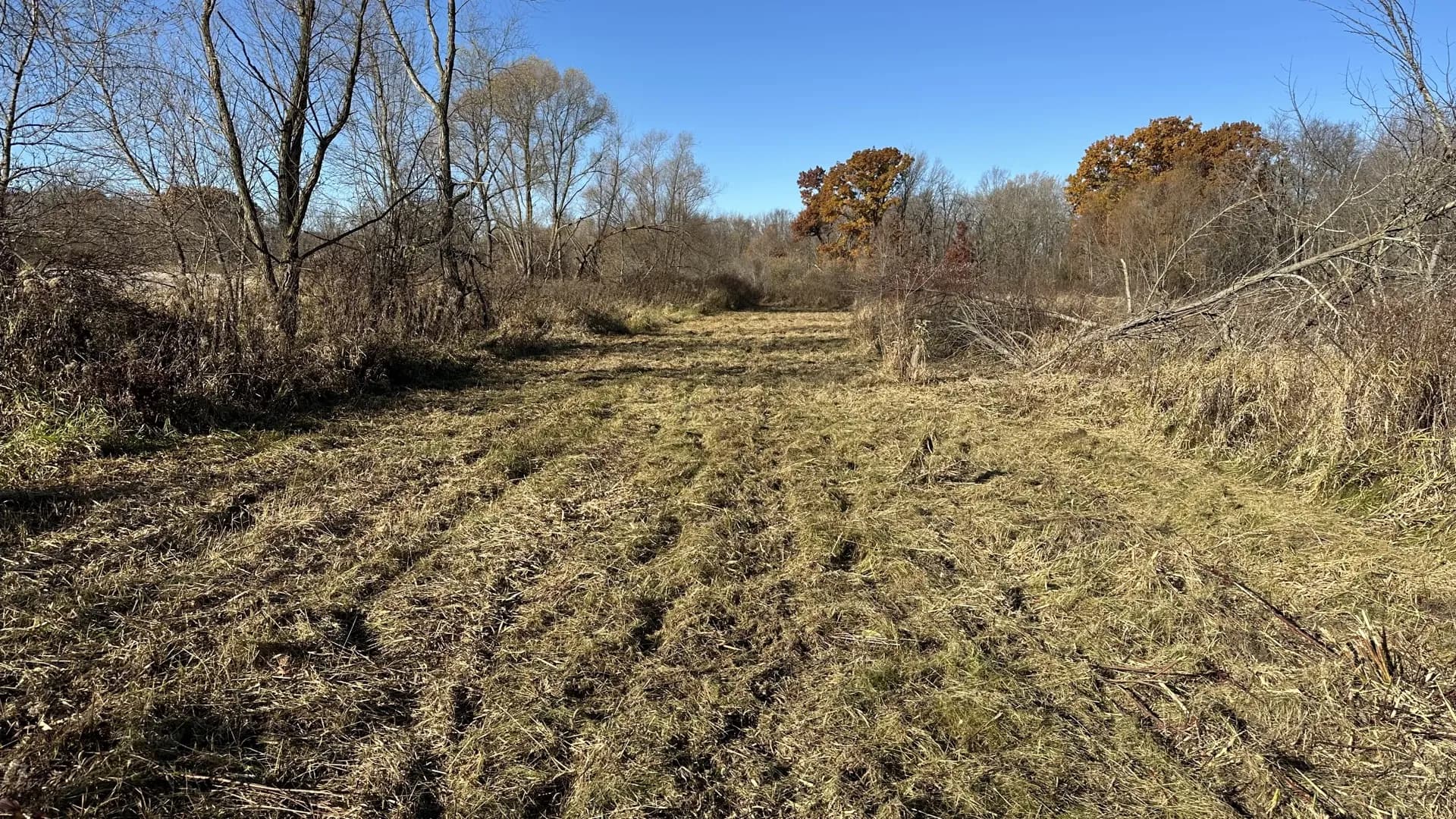
A shooting lane is a cleared line of sight from your stand or blind to the spot where deer travel or feed, cut wide enough to give you a clean, safe shot. You open one by hanging the stand first, sitting in it to mark the sightlines to your trail or food plot, checking your backstop, and then cutting the brush and small trees out of that path. In central Wisconsin most hunters run a bow lane about 10 to 15 feet wide and a gun lane wider and longer, and the fastest way to punch a lane through thick cover is forestry mulching or a brush cutter.
We clear hunting land all over central Wisconsin from our base in Oxford, working across Marquette, Adams, Juneau, Waushara, and the rest of the eight counties around us. A lot of that ground is oak, aspen, and jack pine with a thick understory of buckthorn and honeysuckle, and it grows back fast. This is a rundown of how to cut shooting lanes and hunting trails that actually help you kill deer, how wide and long to make them, and the right time of year to get the work done before the season opens.
What Is a Shooting Lane, and What Is a Hunting Trail?
They sound similar, but they do two different jobs on a hunting property, and you want both.
A shooting lane is a narrow opening cut through brush and timber that gives you a clear shot from your stand to where the deer will be. It is about the shot. You are removing the branches, saplings, and brush that would stop an arrow or block your view of a trail crossing or a food plot edge.
A hunting trail is an access route. It is the path you walk in and out on, and it is about getting to your stand quiet and undetected, without crashing through brush and blowing every deer out of the woods. A good trail also lets you slip in with the wind in your face and keep your scent off the deer's travel routes.
The best hunting properties tie the two together. Quiet trails get you to the stand, and clean lanes give you the shot once you are there. Both of them close in fast in central Wisconsin, so they need a plan and a machine that can keep up.
How Do You Clear Shooting Lanes for Deer Hunting?
The mistake we see most is guys cutting the lane first and hanging the stand second. Do it backward and you end up with a beautiful lane pointing at nothing. Here is the order that works.
- Hang the stand or set the blind first. Pick your spot based on the wind, the deer sign, and your entry route, and get the stand in place before you cut a single branch. The stand decides where the lanes go, not the other way around.
- Sit in it and mark the sightlines. Climb up, sit down, and look at where deer actually move: the trail crossings, the pinch points, the edge of the food plot. Flag those sightlines with tape so you know exactly what to cut.
- Check your backstop and your safe shot. Know what is behind every lane before you clear it. A rise, a heavy tree line, or a hillside makes a safe backstop. Never cut a lane that points at a road, a building, or a neighbor's ground.
- Cut the lane. Open the flagged path just wide enough for a clean shot and no wider. In thick brush and small trees, a mulcher or brush cutter clears it in one pass. For a few branches, hand tools do the job.
- Clean the low stuff and keep the screen. Take out the waist-high brush and saplings that block your view, but leave taller cover on the edges. That screen hides your movement and keeps deer relaxed as they step into the opening.
- Freshen it every year. Buckthorn, honeysuckle, and raspberry come back hard. A quick re-cut before each season keeps the lane open instead of letting it grow shut and force a big clearing job later.
How Wide and How Long Should a Shooting Lane Be?
Wider is not better. A lane too wide turns deer nervous and cuts your cover, and it takes more work to keep open. Size the lane to the weapon and the shot you expect.
- Bow lanes. Keep them tight, about 10 to 15 feet wide, and short, out to 20 to 40 yards. A bow hunter needs a small window, not a highway. Narrow lanes hold deer close and keep them calm.
- Gun and crossbow lanes. These run wider and longer because you are reaching out farther. Many central Wisconsin gun hunters open lanes 100 to 150 yards or more across a field edge or a marsh opening, sized to the ground and a safe backstop.
- Angle them like spokes. Cut several short lanes fanning out from the stand instead of one wide clearing. You cover more trails, keep more cover, and the deer never see one big hole in the woods.
Cut only what the shot needs. On thick central Wisconsin ground, that restraint is also what keeps the lane from growing shut in a single season.
What Is the Best Way to Clear Hunting Trails and Access Routes?
The right tool depends on what is growing and how much you are cutting. On most hunting land we see a mix of all three of these.
Forestry mulching
When the trail or lane runs through brush, saplings, and small trees, forestry mulching is the fastest clean way to open it. The machine grinds the growth into a mulch layer right where it stood, so there is no burn pile, no hauling, and no torn-up ground. The chips make a firm, quiet walking surface on your access trails, which is exactly what you want for slipping in to a stand. It is the move for opening new trails and lanes through thick cover in one pass.
Brush hogging and mowing
Once a trail or lane is open, keeping it open is a mowing job. A brush hog knocks down tall grass, weeds, and light brush across trails, field edges, and food plot borders. It is the right tool for yearly upkeep on ground that is already cleared. Our guide to brush hogging in central Wisconsin covers when mowing is enough and when the growth has gotten past it.
Hand cutting
For a few branches in a bow lane or a light touch-up near the stand, a hand saw and loppers do fine and let you work quiet close to your setup. Hand work is slow and hard on a body once the brush gets thick, so it is best saved for the finish trimming, not the heavy clearing.
Forestry Mulching vs. Brush Hogging vs. Hand Cutting
Here is how the three methods stack up for shooting lanes and hunting trails.
| Method | Best For | What It Handles |
|---|---|---|
| Forestry mulching | Opening new trails and lanes through thick cover | Brush, saplings, and small to mid-size trees, ground to a mulch layer in one pass |
| Brush hogging | Yearly upkeep on trails and lanes already cleared | Tall grass, weeds, and light brush on open ground |
| Hand cutting | Finish trimming close to the stand | A few branches and light saplings in a bow lane |
On a new or overgrown hunting property, the usual play is to mulch the trails and lanes open, then keep them that way with a brush hog each year and a little hand work before the season.
When Is the Best Time to Cut Shooting Lanes in Wisconsin?
Timing matters more for hunting than for most clearing work, because you do not want to be cutting and banging around your stand the week before opener.
- Late winter into early spring. This is the time for the big work: opening new trails, punching in new lanes, and clearing overgrown ground. The deer have all summer and fall to settle back in, and frozen or firm ground means the machine leaves little mess.
- Late summer, a month or two before season. Do your freshening now. Re-cut the lanes that grew in over summer and touch up the shooting windows so the woods have time to calm down before the deer are on alert.
- Not right before opener. Cutting in your core area days before the season puts mature bucks on edge. Get the work done early and let the ground go quiet.
For more on seasonal timing across all kinds of clearing, see our guide to the best time to clear land in Wisconsin.
Do You Need a Permit to Clear Shooting Lanes or Trails?
On your own upland ground, cutting shooting lanes and trails usually does not need a permit, but a few situations change that. Check these before you cut.
- Shoreland zones. If your lanes or trails fall within 300 feet of a river or stream or 1,000 feet of a lake, pond, or flowage, they are in the shoreland zone. Marquette, Adams, Juneau, and the surrounding counties limit how much you can clear near water and require a buffer. Call county planning and zoning first.
- Wetlands. Central Wisconsin has a lot of low, wet ground, and much of the best deer cover sits right against it. Do not clear or fill a wetland without checking with the county and the Wisconsin DNR.
- Public land. You cannot cut lanes or trails on state or county land or on most public hunting ground. That is a fast way to lose your hunting privileges. Lanes are for private property you own or have permission on.
- Invasive brush. A lot of what closes in a lane is buckthorn and honeysuckle, both on the Wisconsin DNR NR 40 invasive list. Clearing them out of your lanes is good for the woods, but haul or chip them rather than spreading the berries and seed around your property.
We work this ground every week and can tell you what your lanes are likely to trigger, but the county zoning office is the final word. A short call before the machine shows up saves a lot of grief.
Where We Clear Hunting Land in Central Wisconsin
We cut shooting lanes, hunting trails, and food plots across our eight-county area from Oxford, including Adams and Friendship, Mauston, Montello, Westfield, and the marsh and timber country around them. This is deer country, and a lot of the folks we work for are turning a new parcel or a grown-over old farm into hunting ground. Whether it is a few lanes off a stand or a full trail system with food plots, we will walk the property with you and lay it out.
Get the trails and lanes right and the whole property hunts better. You slip in undetected, the deer stay relaxed, and when one steps into the opening you have the shot. For a bigger-picture look at getting a parcel ready to hunt, see our guide to hunting land clearing in Wisconsin.
Get a Free Hunting Land Estimate
If you have a stand you want lanes cut off of, an overgrown property that needs trails, or a spot for a new food plot, we can open it up and keep it that way. Call (608) 292-3934 or request your free estimate online, and we will walk the ground with you, mark the lanes and trails, and give you a straight price for the work.
Last updated: July 2026
Frequently Asked Questions About Shooting Lanes and Hunting Trails
How do you clear a shooting lane for deer hunting?
Hang the stand first, then sit in it and flag the sightlines to the trail crossings and food plot edges where deer move. Check that each lane has a safe backstop, then cut the brush and small trees out of the flagged path just wide enough for a clean shot. Take out the low brush that blocks your view but leave taller cover on the edges to screen your movement. Freshen the lane before each season so it does not grow shut.
How wide should a shooting lane be?
Size the lane to the weapon. A bow lane stays tight, about 10 to 15 feet wide and 20 to 40 yards long, so deer hold close and stay calm. A gun or crossbow lane runs wider and longer, often 100 to 150 yards or more across a field edge, sized to the ground and a safe backstop. Cut several short lanes fanning out from the stand instead of one wide clearing so you keep more cover.
What is the difference between a shooting lane and a hunting trail?
A shooting lane is a cleared line of sight from your stand to where the deer will be, cut for a clean shot. A hunting trail is an access route, the quiet path you walk in and out on so you can reach the stand undetected without blowing deer out of the woods. Good hunting properties use both: trails to get in, lanes to get the shot.
What is the best way to clear hunting trails through thick brush?
For opening new trails and lanes through brush, saplings, and small trees, forestry mulching is the fastest clean way. The machine grinds the growth into a mulch layer in one pass with no burn pile and no hauling, and the chips make a firm, quiet walking surface. Once a trail is open, a brush hog handles the yearly upkeep, and hand tools work for finish trimming close to the stand.
When is the best time to cut shooting lanes in Wisconsin?
Do the big work, opening new trails and lanes, in late winter or early spring so the deer have all season to settle back in. Freshen the lanes that grew in over summer about a month or two before season. Avoid cutting in your core hunting area the week before opener, since the noise and disturbance puts mature bucks on edge right when you want them calm.
Do you need a permit to clear shooting lanes on your own land?
On your own upland ground, cutting shooting lanes and trails usually does not need a permit. It changes if the work is in a shoreland zone, within 300 feet of a river or 1,000 feet of a lake, or in a wetland, where county and Wisconsin DNR rules limit clearing near water. You cannot cut lanes on public hunting land. Call your county planning and zoning office if your ground is near water.
Do you clear hunting land and shooting lanes near Adams County and Mauston?
Yes. We cut shooting lanes, hunting trails, and food plots across our eight-county central Wisconsin area from our base in Oxford, including Adams and Friendship, Mauston, Montello, Westfield, and the marsh and timber country around them. Call (608) 292-3934 or request a free estimate online, and we will walk the property with you and lay out the trails and lanes.