
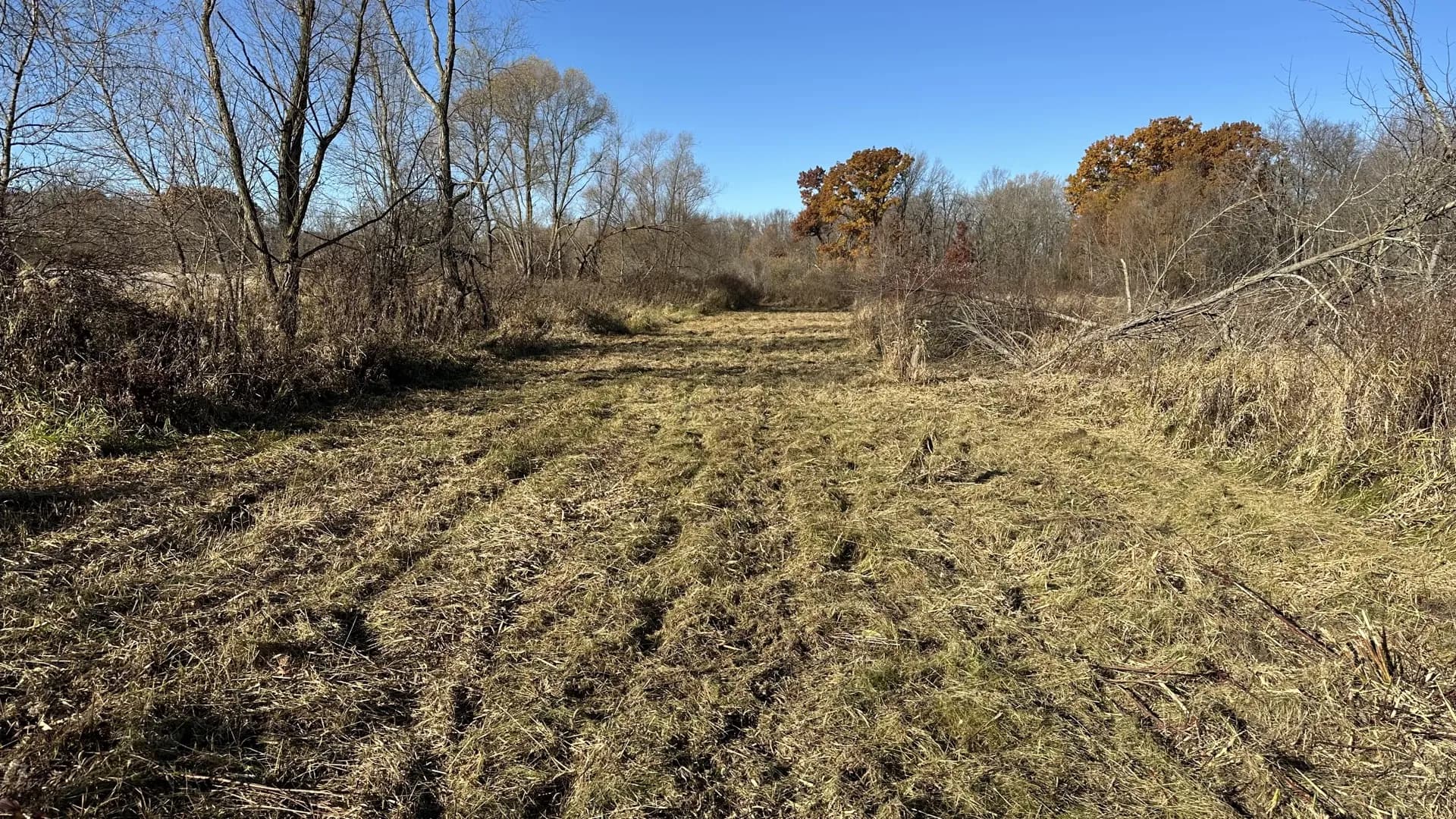
Creating a food plot in central Wisconsin starts with choosing the right location (south-facing, near bedding cover, 1/4 to 2 acres), clearing the site with forestry mulching, running a UW Extension soil test, amending with lime and fertilizer, and planting species suited to your soil type. Sandy Central Sands soil needs extra lime and works best with clover, brassicas, and cereal rye.
We clear and prep dozens of food plots every year across Adams, Marquette, and Waushara counties. Most of the landowners we work with are managing property for whitetail deer hunting. Here is the step-by-step process we recommend based on what actually works in this part of Wisconsin.
Step 1: Choose the Right Location
Location makes or breaks a food plot. A perfectly planted plot in the wrong spot will not attract deer. Here is what to look for:
Proximity to bedding areas: Deer do not like crossing wide-open areas to reach food. Place your plot within 100 to 200 yards of known bedding cover. In central Wisconsin, this usually means thick brush, cattail marshes, or dense pine stands. Deer should be able to step out of cover and right into the food source.
South-facing slopes: South-facing slopes get more sunlight hours and warm up faster in spring. This means earlier green-up and a longer growing season for your plot. In the rolling terrain around Montello and the Marquette County hills, south-facing slopes are easy to find.
Plot size: For a hunting food plot, 1/4 acre to 2 acres is the sweet spot. Smaller than 1/4 acre and deer will over-browse it in a few weeks. Larger than 2 acres and deer spread out too much, making it harder to pattern them. For purely attracting and feeding deer (not hunting over the plot), bigger is fine.
Wind direction: Think about your prevailing wind direction and how you will hunt the plot. You want to be able to access your stand without crossing the plot or blowing scent across it. In central Wisconsin, prevailing fall winds are from the west and northwest.
Soil drainage: Avoid low spots that hold water. Standing water kills food plot plants. The sandy soil in the Central Sands drains well almost everywhere, which is an advantage. If you are in the clay soils of Columbia County or Sauk County, pay more attention to drainage.
Step 2: Clear the Site
Forestry mulching is the fastest and most effective way to clear a food plot site. Here is why it beats other methods for this specific application:
- No stumps: The mulcher grinds stumps to grade, so you have a smooth surface to plant on. No dodging stumps with a disk or ATV sprayer.
- Mulch adds organic matter: The ground-up wood chips break down over one growing season and add organic matter to sandy soils that desperately need it.
- Minimal debris to haul: Most material stays on-site as mulch — no brush piles, no burn piles. Larger trees are felled and removed before the mulcher runs, but everything else gets ground in place.
- Selective clearing: We can leave specific mast-producing trees (oaks, hickories) standing while clearing the brush around them. These trees provide additional food sources and transition cover.
For a typical 1-acre food plot in the Central Sands area, food plot clearing takes about half a day with our equipment. We can clear the site and have it ready for the next step by afternoon.
Timing tip: Clear your food plot site in fall or winter if possible. This gives the mulch layer 4 to 6 months to start decomposing before spring planting. If you clear in spring, you can still plant that same season, but you may need to rake or disk through the fresh mulch layer first.
Step 3: Test Your Soil
Do not skip this step. A $25 soil test from the UW Extension will save you hundreds of dollars in wasted seed and fertilizer.
Order a soil test kit from the UW Soil Testing Lab in Madison. Take samples from 6 to 8 spots across your plot at a depth of 4 to 6 inches. Mix the samples together and send them in. Results come back in 1 to 2 weeks.
What to expect in central Wisconsin soils:
- pH: Central Sands soil is typically acidic, often in the 5.0 to 5.5 range. Most food plot plants want a pH of 6.0 to 7.0. You will almost certainly need lime.
- Organic matter: Sandy soils are low in organic matter, often under 2 percent. This is why the mulch layer from clearing is so valuable.
- Phosphorus and potassium: Variable, but often low in sandy soils. Your soil test results will include specific recommendations for how much to add.
Step 4: Amend the Soil
Based on your soil test, you will likely need lime and fertilizer. Here is what to expect for a typical Central Sands food plot.
Lime
Sandy acidic soils typically need 2 to 4 tons of agricultural lime per acre to raise the pH into the 6.0 to 6.5 range. Ag lime is cheap (about $40 to $60 per ton delivered in our area), but it takes 3 to 6 months to fully react with the soil. Apply lime in fall for a spring planting, or as early as possible before planting.
Pelletized lime works faster but costs more. If you are in a hurry, use pelletized lime at half the rate to get a quicker pH bump, then follow up with ag lime for long-term correction.
Fertilizer
Follow your soil test recommendations. A general starting point for sandy Central Sands food plots:
- Clover plots: 0-20-20 at 200 to 300 lbs per acre (clover fixes its own nitrogen)
- Brassica plots: 19-19-19 at 200 to 300 lbs per acre
- Cereal rye/oats: 46-0-0 (urea) at 100 to 150 lbs per acre
You can buy fertilizer at local farm supply stores in Westfield, Montello, or Wautoma. Spreading by hand with a broadcast spreader works fine for plots under 2 acres.
Step 5: Plant the Right Species
What you plant depends on when you plant and what you want the plot to do. Here are the best options for central Wisconsin food plots.
Fall Planting (August - September)
- Brassicas (turnips, radishes, rape): Plant in late August. Brassicas are whitetail magnets after the first hard frost sweetens the leaves. They grow fast and produce a lot of tonnage. The large taproot of forage radishes also breaks up compacted soil. Plant at 5 to 8 lbs per acre.
- Cereal rye: Plant in September through early October. Cereal rye is the most cold-tolerant food plot option and will keep growing into November after everything else has quit. It provides green forage through winter and early spring. Plant at 100 to 120 lbs per acre.
- Winter oats: Plant in August to early September. Oats attract deer in fall but will winterkill, leaving a natural mulch layer that suppresses weeds the following spring.
Spring Planting (May - June)
- White clover (Ladino): The gold standard for perennial food plots. Plant in May once soil temperatures are consistently above 50 degrees. Clover fixes nitrogen, tolerates browsing, and comes back year after year with minimal maintenance. Plant at 8 to 10 lbs per acre.
- Red clover: Larger plants than white clover, better for sandy soils. Lasts 2 to 3 years before reseeding is needed. Plant at 10 to 12 lbs per acre.
- Chicory: Mix with clover for a diverse perennial plot. Chicory has a deep taproot that pulls minerals from deep soil layers. Plant at 3 to 5 lbs per acre mixed with clover.
Summer Planting (Late May - June)
- Soybeans: High-protein summer food source. Eagles are expensive but deer love them. Plant at 50 to 60 lbs per acre. In the Central Sands, soybeans grow well in the sandy soil with adequate moisture.
- Lablab: A tropical legume that does surprisingly well in Wisconsin summers. Plant after frost danger is past (late May). Deer browse it heavily, so plant at least 1 acre so it can outgrow the browsing pressure.
Step 6: Maintain Your Plot
A food plot is not a plant-it-and-forget-it project. Here is the basic annual maintenance schedule for central Wisconsin.
- Mow clover plots: Mow 2 to 3 times per summer at 6 to 8 inches to keep clover from going to seed and to control weeds. Time the last mowing for early September so the plot has fresh growth going into hunting season.
- Frost seed clover: In late February or early March, broadcast clover seed over existing plots while the ground is still doing freeze-thaw cycles. The seed works itself into the soil naturally. This freshens thin clover stands without having to till.
- Soil test every 2 to 3 years: Retest and adjust lime and fertilizer as needed. Sandy soils leach nutrients faster than clay soils, so regular testing matters more here.
- Spray for weeds if needed: Clethodim kills grass in clover plots. Glyphosate can be used on Roundup Ready soybeans. Avoid broad-spectrum herbicides that kill your food plot plants.
Wisconsin Deer Browse Patterns in Central Wisconsin
Understanding how whitetails use food plots in our area helps you plan better.
In Adams, Marquette, and Waushara counties, deer herds are healthy but not overabundant like in the agricultural zones of southern Wisconsin. Food plots here are a real draw because large-scale agriculture is less common in the sandy Central Sands. Your food plot may be the best food source for miles, which concentrates deer activity.
Fall browse patterns in our area: deer hit brassicas hard after the first frost (usually mid to late October). By November, they transition to cereal rye and any remaining clover. In late December and January, the cereal rye plot becomes the primary green food source when everything else is dormant or buried in snow.
For year-round attraction, we recommend a minimum of two plots: one perennial clover plot for spring through fall, and one annual brassica/cereal rye plot for fall through winter.
Get Your Food Plot Cleared This Season
We handle the hardest part of food plot creation: clearing the site. Our food plot clearing service takes a wooded or overgrown area and turns it into a smooth, plantable surface in a single day. We can also help with ongoing land management to keep your property in top shape for wildlife.
We serve hunters and landowners across central Wisconsin including Oxford, Montello, Westfield, Wautoma, Adams, Wisconsin Dells, and the surrounding area. Call (608) 292-3934 or get your free estimate online.
Last updated: March 2026
Frequently Asked Questions About Food Plots in Wisconsin
What is the best food plot for deer in Wisconsin?
The best year-round food plot strategy for Wisconsin deer is a perennial white clover plot for spring through fall browsing, combined with a fall-planted brassica and cereal rye plot for late season attraction. Clover provides protein from May through October, while brassicas and rye draw deer from October through February.
How big should a food plot be for deer in Wisconsin?
For a hunting food plot designed to pattern deer, 1/4 acre to 2 acres is ideal. Plots smaller than 1/4 acre get over-browsed quickly. Plots larger than 2 acres spread deer activity too thin for effective hunting. For attraction-only plots where you are not hunting over them, larger is fine.
When should I plant a food plot in Wisconsin?
For spring planting, plant clover in May when soil temperatures reach 50 degrees. For fall planting, plant brassicas in late August and cereal rye in September through early October. Soybeans and other warm-season plants go in after the last frost in late May. The specific timing varies slightly between the warmer southern tier and cooler northern tier of central Wisconsin.
How much does it cost to create a food plot in Wisconsin?
Total cost for a 1-acre food plot in central Wisconsin includes clearing (forestry mulching — contact us for a free estimate), about $25 for a soil test, $150 to $300 for lime, $75 to $150 for fertilizer, and $50 to $120 for seed. Clearing is the largest expense and varies by vegetation density. Annual maintenance costs are typically $150 to $350 for seed, fertilizer, and lime top-ups.
Can you plant a food plot in sand?
Yes, but sandy soil in the Central Sands needs amendments. Test your soil pH first. Sandy soils are usually acidic (pH 5.0 to 5.5) and need 2 to 4 tons of lime per acre to reach the 6.0 to 6.5 range that food plot plants prefer. Sandy soil also drains fast, so choose drought-tolerant species like red clover, chicory, and cereal rye. Avoid moisture-demanding plants like alfalfa unless you have irrigation.