
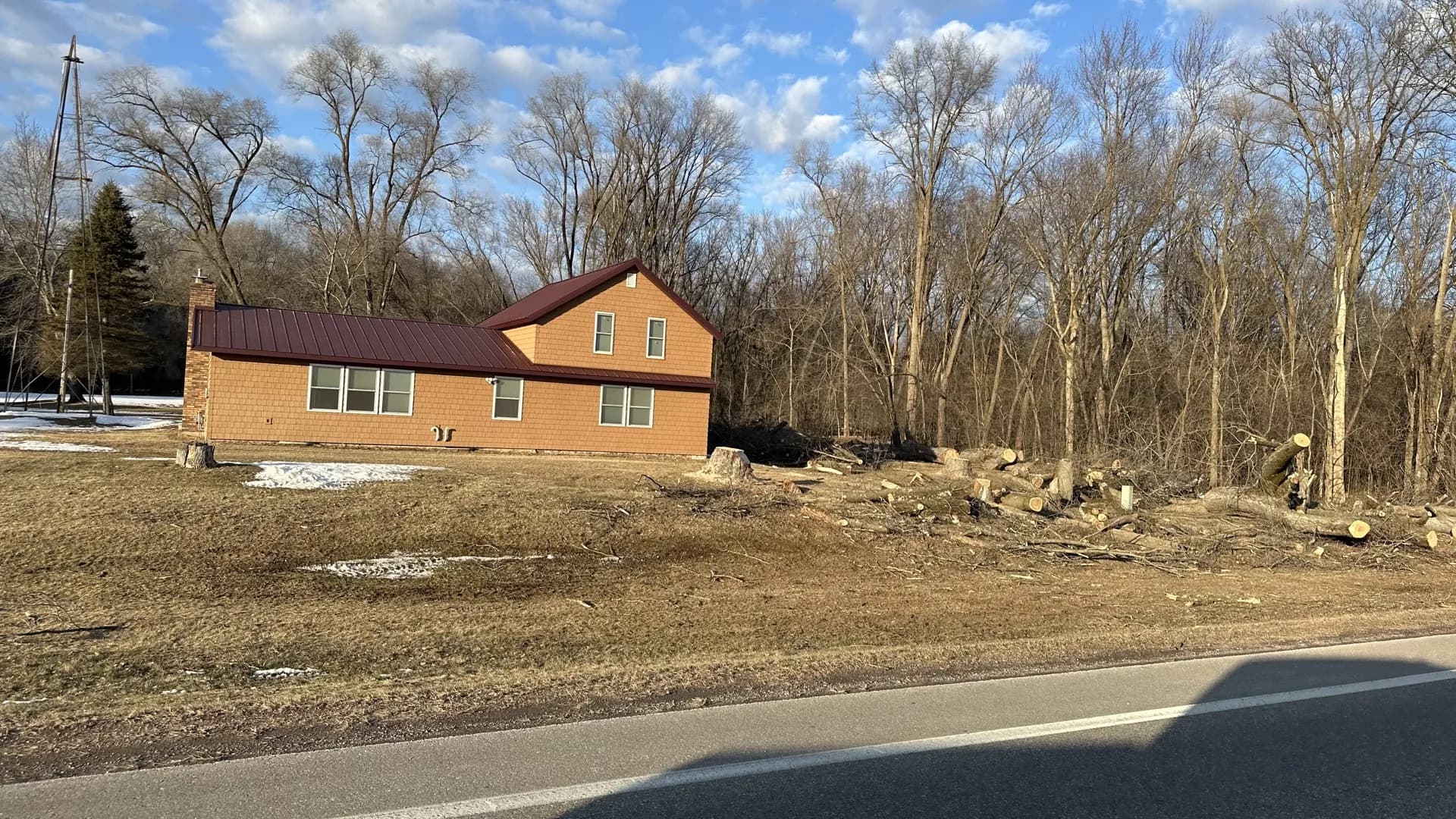
Lot clearing is the work of opening up a wooded or overgrown parcel so you can build on it. You clear the trees and brush off the building pad, the driveway path, and the septic and well area, then grade the ground so it drains and holds a foundation. In central Wisconsin, clearing a building lot usually runs about $600 to $1,200 per acre for average wooded ground, less for scattered trees and more for heavy timber or steep, wet lots. Most building lots are priced as one flat job rather than by the acre, because the work is selective and the driveway, grading, and stump removal all factor in.
We clear building lots all over central Wisconsin from our base in Oxford, working across Marquette, Adams, Waushara, Columbia, Sauk, and the rest of the eight counties around us. A lot of the parcels out here started as woods or old pasture, and the folks buying them want to put up a house, a cabin, a pole shed, or a hunting camp. This is a rundown of what lot clearing actually involves, what it costs, and how to get a raw wooded lot ready to build without creating a drainage or erosion mess you pay for later.
What Is Lot Clearing?
Lot clearing is clearing a specific parcel so it can be built on or used. It is a narrower job than general land clearing. When someone says land clearing they often mean opening up acreage for a field, a food plot, or pasture. Lot clearing is aimed at a build. That changes how the work gets done. You are not clearing everything flat. You are opening the exact footprint the project needs and usually leaving a screen of trees around the edges for shade, privacy, and looks.
On a typical central Wisconsin building lot, that means clearing the house or cabin pad, the path for the driveway, the spot for the septic system and drain field, the well location, and enough working room around the foundation for the builder and the concrete trucks. Good trees you want to keep get flagged and left standing. Everything in the footprint comes out.
How Much Does Lot Clearing Cost in Wisconsin?
The cost of clearing a lot comes down to how thick the trees are, how big they are, how much of the parcel you are opening up, and what has to happen to the ground after. Light scrub on a small lot is cheap. A full acre of mature oak with stumps pulled and the pad graded is not. Here are the working ranges we see for wooded ground in our area.
| Lot Condition | What It Looks Like | Typical Cost Per Acre |
|---|---|---|
| Light | Scattered trees, brush, and saplings with open ground between them | $400 to $600 |
| Average wooded | A normal stand of trees and understory, the most common building lot | $600 to $1,200 |
| Heavy | Big mature timber, dense growth, steep or wet ground, stumps pulled and hauled | $1,500+ |
Those are per-acre ranges to give you a feel for it, not a quote. Most building lots get priced as one flat number for the whole job. The reason is that a build lot is selective work. We are clearing a pad and a driveway and leaving a tree line, not mowing the whole parcel, so the acre math does not tell the real story. What moves the price on a lot is the size of the footprint you are opening, whether the stumps come out or stay, how far the driveway runs to the building site, and whether the ground needs grading and hauling after. For more on what drives the number, see our guide to land clearing cost in Wisconsin.
What Are the Steps to Clear a Building Lot?
A building lot is not a job you want to rush or do out of order. Clear the wrong ground or skip the drainage and you can make the build harder and cost yourself money down the road. Here is the order we work in on a homesite.
- Walk the lot and mark the plan. Before anything runs, we walk the parcel with you and stake out the building pad, the driveway path, and the septic and well area. Trees worth keeping get flagged. This is where a rough sketch from your builder helps.
- Check boundaries and call Diggers Hotline. Know where your lines actually run so you are not clearing onto a neighbor. Wisconsin law requires calling 811 (Diggers Hotline) to locate buried utilities before any digging or stump work.
- Clear the building footprint. We take out the trees and brush across the pad and the working room the builder needs around it. On average ground, forestry mulching grinds the standing growth into a mulch layer in one pass with no burn pile and no hauling.
- Open the driveway path. The driveway has to reach the building site, so we clear its run at the same time. Getting the access in early means the concrete trucks, lumber deliveries, and the well rig can all get to the pad.
- Deal with the stumps. For a foundation and driveway you usually want the stumps gone, not just the trees. We grind or pull the stumps in the pad and driveway so the ground can be compacted and built on.
- Grade the pad and set drainage. The pad gets rough graded so it drains away from where the house will sit. On sandy central Wisconsin ground this matters less than on clay, but water still has to have somewhere to go.
- Control erosion on bare ground. Freshly cleared soil washes if it is left open on any slope. Seeding the disturbed ground or leaving a mulch cover holds it until the build takes over. On lots near water this step is often required, not optional.
Forestry Mulching or Traditional Clearing for a Building Lot?
There are two main ways to clear a lot, and the right one depends on the lot and the build. Both have a place.
Forestry mulching
A mulcher chews standing trees and brush into a mulch layer right where they grew. There is no burn pile, no hauling, and no torn-up ground. The chips break down and feed the soil, and the machine works in a single pass. For opening a building pad, a driveway path, and a tree-lined homesite, mulching is fast, clean, and easy on the parts of the lot you are keeping. The limit is stump size. A mulcher takes trees down to a low stump but does not pull the root ball, so if you need the pad completely stump-free for a foundation, you follow up with stump grinding.
Traditional clearing
Traditional clearing uses an excavator or dozer to push, dig, and pile. It is the move when you want stumps out by the root and the ground worked and graded in the same go, or when the timber is too big to mulch cheaply. The tradeoff is more soil disturbance, a debris pile to burn or haul, and a heavier footprint on the lot. For a lot of homesites the best answer is a mix: mulch the standing growth, then bring in the machine to pull stumps and grade the pad. Our post on forestry mulching versus traditional clearing breaks down when each one wins.
Do You Need a Permit to Clear a Lot in Wisconsin?
For a normal building lot away from water, clearing the trees itself usually does not need a permit, but the build around it does, and a few situations change the answer. Check these before you start.
- Shoreland zoning. If your lot sits within 300 feet of a river or stream or 1,000 feet of a lake, pond, or flowage, it falls in the shoreland zone. Marquette, Adams, Columbia, and Sauk counties all limit how much you can clear near the water and require you to leave a buffer strip. Call county planning and zoning first.
- Erosion control. Many counties require an erosion control plan once you disturb ground for construction, especially on a slope or near water. It is often folded into the building permit.
- Wetlands. Do not clear or fill a wetland without checking with the county and the DNR. Central Wisconsin has a lot of low, wet ground, and the rules there are strict.
- Driveway access permit. A new driveway connecting to a county or state road usually needs an access permit from the highway department.
We deal with these lots every week and can tell you what your parcel is likely to trigger, but the county zoning office is the final word. A ten-minute call before the machine shows up saves a lot of grief.
When Is the Best Time to Clear a Building Lot?
You can clear a lot any time of year in Wisconsin, but a couple of windows make the work cleaner and cheaper.
- Winter, on frozen ground. Frozen ground is the best surface for clearing. The machines leave almost no ruts, the mess is minimal, and access is easy. Clearing over winter also sets you up to break ground as soon as the frost is out in spring.
- Late fall. After the leaves drop and before deep snow, the ground is firm and you can see the lot clearly to lay out the pad and driveway.
- Summer. Fine on well-drained sandy ground, which is most of our area. On low or clay ground, summer rain can turn a lot soft and rut it up, so timing matters more there.
If you are planning a spring or summer build, clearing the lot the winter before is the smart play. For more on seasonal timing, see our guide to the best time to clear land in Wisconsin.
Where We Clear Building Lots in Central Wisconsin
We clear building lots and homesites across our eight-county area from Oxford, including Wisconsin Dells, Adams and Friendship, Montello, Westfield, Portage, and Baraboo, plus the smaller towns in between. A lot of the parcels around the Dells and Adams County are recreational lots people are turning into cabins and homes, and the wooded ground out here clears well with the right machine. Whether it is a half-acre cabin lot or five acres for a house and a shop, we will come look and give you a straight price.
Getting the lot cleared right is the first real step in a build. Do it in the right order, keep the good trees, and handle the drainage, and you hand your builder a pad that is ready to go.
Get a Free Lot Clearing Estimate
If you have a wooded lot you want to build on, we can clear the pad, open the driveway, take out the stumps, and get the ground ready. Call (608) 292-3934 or request your free estimate online, and we will walk the lot with you, mark out the building site, and give you one flat price for the job.
Last updated: July 2026
Frequently Asked Questions About Lot Clearing
How much does it cost to clear a lot in Wisconsin?
Clearing a wooded building lot runs about $400 to $600 per acre for scattered trees and brush, $600 to $1,200 for average wooded ground, and $1,500 or more per acre for heavy timber or steep, wet lots with stumps pulled. Most building lots are priced as one flat job instead of by the acre, because the work is selective and the driveway, stump removal, and grading all factor in. We give one flat price after a free on-site look.
What is the difference between lot clearing and land clearing?
Land clearing is a general term for opening up acreage, often for a field, pasture, or food plot. Lot clearing is aimed at a build. You clear a specific footprint, the building pad, the driveway path, and the septic and well area, and usually leave a screen of trees around the edges for privacy and shade. Lot clearing is more selective and is tied to getting the ground ready for a foundation.
Do you remove stumps when clearing a building lot?
For the building pad and driveway, yes. A foundation and a compacted driveway need the stumps gone, not just the trees cut. We grind or pull the stumps in those areas so the ground can be built on. Trees you are keeping around the edges of the lot are left standing with their roots intact. Forestry mulching alone takes trees to a low stump, so we follow up with stump work where the build requires clean ground.
Do I need a permit to clear my lot in Wisconsin?
Clearing trees on a normal building lot away from water usually does not need a permit on its own, but the construction does, and shoreland lots are different. If your lot is within 300 feet of a river or 1,000 feet of a lake or pond, it is in the shoreland zone and county rules limit clearing near the water. Erosion control plans and driveway access permits are also common. Call your county planning and zoning office before you start.
Should I use forestry mulching or an excavator to clear my lot?
Forestry mulching is fast and clean for opening the pad, the driveway, and a tree-lined homesite, with no burn pile and little soil disturbance, but it leaves low stumps. An excavator or dozer pulls stumps by the root and grades in the same pass but disturbs more ground and leaves a debris pile. Many homesites use both: mulch the standing growth, then bring in the machine to pull stumps and grade the pad.
When is the best time to clear a lot to build?
Winter, on frozen ground, is the cleanest time to clear a lot. The machines leave almost no ruts, the mess is minimal, and it sets you up to break ground in spring. Late fall works well too, with firm ground and clear sightlines to lay out the pad. Summer is fine on the sandy, well-drained ground common in central Wisconsin, but low or clay lots can rut up after rain.
Do you clear building lots near Wisconsin Dells and Adams County?
Yes. We clear building lots and homesites across our eight-county central Wisconsin area from our base in Oxford, including Wisconsin Dells, Adams and Friendship, Montello, Westfield, Portage, and Baraboo. A lot of that work is recreational lots being turned into cabins and homes. Call (608) 292-3934 or request a free estimate online.