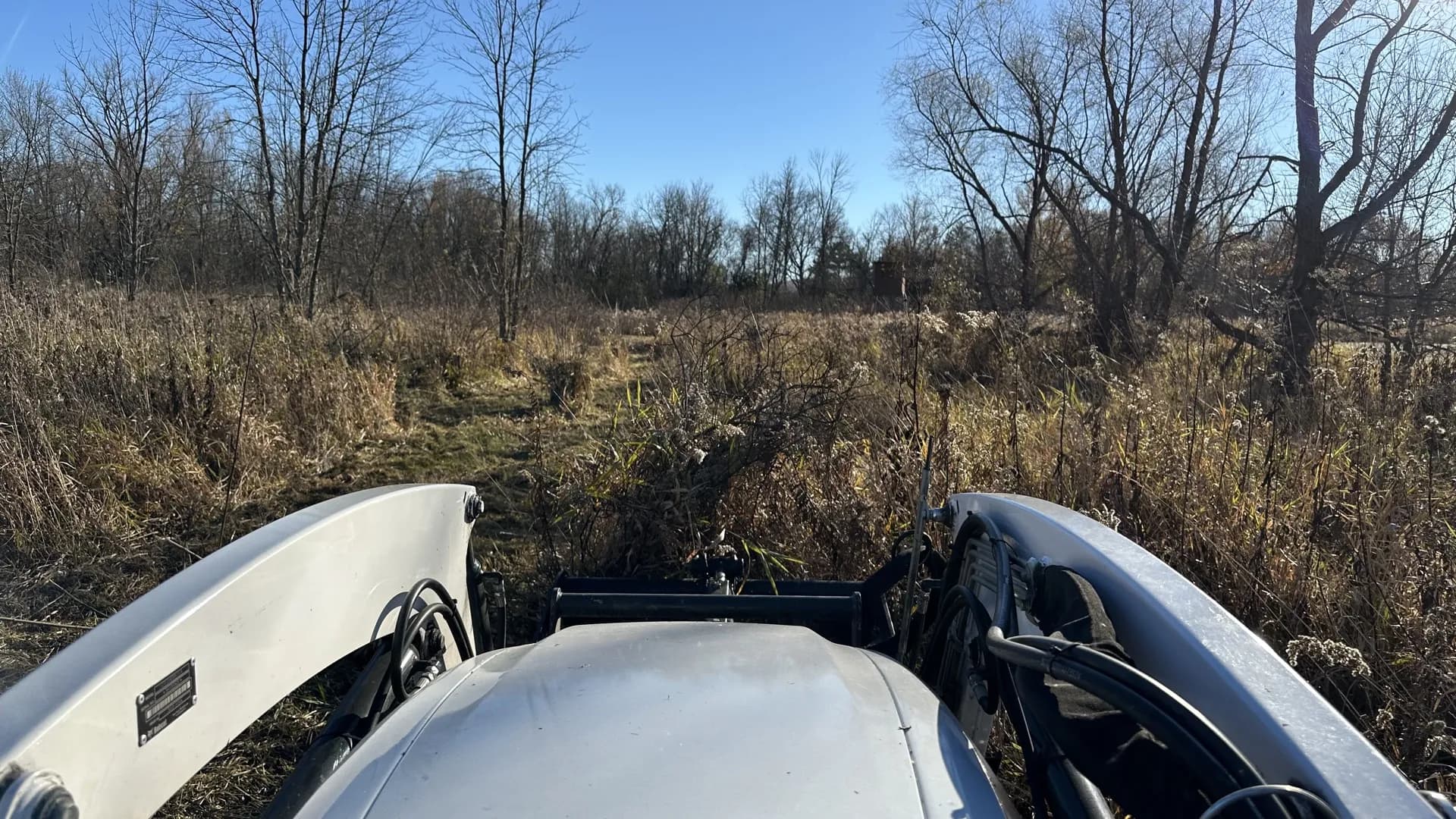
Bush honeysuckle removal in Wisconsin takes two steps. First you cut or mulch the woody shrubs, then you treat the cut stumps with herbicide so the roots do not resprout. Bush honeysuckle is an invasive shrub on the Wisconsin DNR's NR 40 restricted list, and cutting it alone makes it come back thicker. The fastest way to clear a honeysuckle-choked woods is to mulch the thicket to the ground and follow up with a cut-stump or foliar herbicide treatment.
We pull bush honeysuckle out of woodlots, fence lines, and hunting land all over central Wisconsin, working out of Oxford across Marquette, Waushara, Columbia, Sauk, and the rest of the counties around us. If you have an understory of arching shrubs that green up before anything else in spring and still hold their leaves when the oaks are bare, you are most likely looking at honeysuckle. Here is what it is, how to tell it apart from the buckthorn it often grows next to, and how to get rid of it so it does not come right back.
What Is Bush Honeysuckle and Why Is It Bad in Wisconsin?
Bush honeysuckle is a group of woody shrubs brought over from Asia and Europe as ornamental hedge plants. The three we deal with most in central Wisconsin are Tartarian (Lonicera tatarica), Morrow's (Lonicera morrowii), and Bell's honeysuckle (Lonicera x bella), which is a cross of the first two. The DNR lists all of them as restricted under NR 40, the state's invasive species rule, so they are illegal to sell, plant, or move.
The trouble starts with how early it wakes up. Bush honeysuckle is one of the first shrubs to leaf out in spring and one of the last to drop in fall, so it grabs sunlight on both ends of the season and shades out the forest floor when native plants need the light most. Under a heavy stand you get bare dirt and almost nothing growing but more honeysuckle. The red berries look like a good bird food, but they are mostly sugar with little fat, which is poor fuel for birds heading into migration, and the birds spread the seed all over the property. Dense thickets also crowd out the young oaks, native shrubs, and ground cover that deer and turkey actually use. For hunting land, a woods full of honeysuckle holds far less of the browse and cover that game wants.
How Do You Identify Bush Honeysuckle?
Honeysuckle and buckthorn often grow in the same woods, and people mix them up. The good news is honeysuckle has a few tells that make it easy once you know them. Like buckthorn, it is easiest to spot in early spring when it is the green shrub in a gray woods, or in late fall when it is the last one holding leaves.
- Opposite leaves. The leaves grow in matched pairs straight across from each other on the twig. They are oval, come to a point, and have smooth edges with no teeth.
- Hollow stems. This is the surest single tell. Snap an older branch and the center pith is hollow or brown and papery. Native honeysuckles and most other shrubs have solid white pith.
- Arching, multi-stem shape. It grows as a fountain of several arching stems from the base, often six to fifteen feet tall, not a single trunk.
- Flowers and berries. Tubular white, pink, or pale yellow flowers in pairs in May and June, followed by paired red or orange berries through summer and fall.
- Shaggy bark. Older stems have gray-brown bark that peels in long strips.
If the shrub has thorns and bright orange under the bark when you scratch it, that is buckthorn, not honeysuckle. The control is similar, and we often clear both off the same parcel. Our post on buckthorn removal in Wisconsin covers that one in detail.
How Do You Get Rid of Bush Honeysuckle for Good?
This is where most people lose the battle. They cut the honeysuckle down, the woods looks clear, and by the next summer it is back from the stump thicker than before. Honeysuckle resprouts hard when you just cut it. To kill the plant you have to deal with the roots. Here is the order we work in.
- Clear the top growth. For a thick stand, forestry mulching grinds the standing shrubs into a mulch layer in one pass and takes the stems to the ground. For a few scattered shrubs, hand cutting works fine.
- Treat the cut stumps. Right after cutting, the fresh stump gets a herbicide treatment so the root pulls it down. This is the step that actually kills the shrub instead of pruning it.
- Pull the small stuff. Young honeysuckle has shallow roots and comes out of the ground with a weed wrench or by hand, especially in soft spring soil. If you catch a patch early, pulling can be all it takes.
- Time the treatment right. Late summer through the dormant season is the best window for cut-stump and foliar work. The plant is moving sugars to the roots, so it carries the herbicide down with them, and the natives are going dormant so there is less to hit.
- Watch for resprouts and seedlings. The seed bank in the soil stays alive for years. The spring and summer after the work, you walk the ground and pull or spot-treat the new seedlings before they get woody.
- Let the natives come back. Once the honeysuckle is gone and light reaches the forest floor again, native grasses, wildflowers, and tree seedlings start to recover. On open ground you can seed it or put in a food plot.
Our invasive species control work covers the clearing and the follow-up treatment together, so you are not left with a fresh crop of resprouts the next year.
Does Forestry Mulching Kill Honeysuckle?
On its own, no, and it is worth being straight about that. A mulcher takes the honeysuckle down to ground level and chews it into mulch, which clears the woods and knocks out the seed source for that year. But the roots are still alive and they will resprout. What mulching does is make the rest of the job easy. Instead of crawling through a wall of brush to reach each stem, you have open ground and low stumps you can actually get to. We mulch the thicket, then treat the stumps or spray the regrowth in the right season. That pairing is what kills it. Mulching alone is a reset, not a cure.
For a small patch you can skip the machine and do cut-stump treatment or hand pulling. For an acre or more of solid honeysuckle, mulching first saves a mountain of labor and gets you a usable woods in a day instead of a season of hand work. We run that work as part of ongoing land management for owners who want their woods kept ahead of the invasives year to year.
How Much Does Bush Honeysuckle Removal Cost in Wisconsin?
Cost comes down to how thick the honeysuckle is, how big the stems have gotten, and whether you are doing the herbicide follow-up. Mulching a honeysuckle stand falls in the same range as our other brush work. Here is what to expect per acre.
| Infestation | What It Looks Like | Typical Cost Per Acre |
|---|---|---|
| Light | Scattered shrubs with open ground between them, easy to walk | $400 to $600 |
| Moderate | Continuous understory of honeysuckle, hard to walk through | $600 to $1,200 |
| Heavy | Solid wall of mature shrubs, tall stems, years of growth | $1,500+ |
Those are working ranges, not a quote. The herbicide follow-up is a separate line that depends on how much there is to treat. Small jobs carry a minimum or flat rate because the machine still has to be loaded, trailered out, and unloaded. We give one flat price for the whole job after a free on-site look, and you can read more on what moves the number in our guide to forestry mulching cost in Wisconsin.
When Is the Best Time to Remove Honeysuckle in Wisconsin?
There is no truly bad season to mulch honeysuckle, but the herbicide step has a clear window.
- Late summer through fall. The best stretch for cut-stump and foliar treatment. The shrub is pulling sugars down to the roots, so the herbicide goes with them, and you get a clean kill heading into winter.
- Early spring. The easiest time to find honeysuckle, since it greens up weeks before the natives. It is also the best time to hand-pull young plants out of soft, thawing ground.
- Winter. Frozen ground is prime for mulching. The machine leaves almost no mark, and clearing then sets you up to treat resprouts the following season.
If your land is near a lake, creek, or wetland, check with your county zoning office before any herbicide work near water. A lot of our ground around Montello and the Fox River sits close to wet edges, and the rules tighten up inside the shoreland zone.
Where We Remove Bush Honeysuckle in Central Wisconsin
We clear honeysuckle and other invasive brush across our eight-county area from our base in Oxford, including Montello, Westfield, Portage, Baraboo, and Wisconsin Dells, plus the smaller towns in between. Whether it is a backyard woodlot taken over by one season of growth or forty acres of hunting land that has been losing ground for a decade, we will come look and give you a straight price.
Get the honeysuckle out and your woods come back to life. The oaks regenerate, the ground cover fills in, and the land hunts and looks the way it should.
Get a Free Honeysuckle Removal Estimate
If you have a woods or fence line full of bush honeysuckle, we can clear it and treat it so it does not come back. Call (608) 292-3934 or request your free estimate online, and we will walk the property with you, flag the honeysuckle and anything else invasive, and give you one flat price for the job.
Last updated: June 2026
Frequently Asked Questions About Bush Honeysuckle Removal
How do you permanently get rid of bush honeysuckle?
You have to kill the roots, not just cut the top. Cut or mulch the shrubs to the ground, then treat the fresh cut stumps with herbicide so the root takes it up. Cutting alone makes honeysuckle resprout thicker. For a heavy stand, mulching first clears the thicket so the stumps are easy to reach and treat, and you walk the ground the next season to catch any seedlings.
How do I tell bush honeysuckle from buckthorn?
Honeysuckle has leaves in matched pairs straight across from each other, smooth leaf edges, and a hollow or brown papery center when you snap an older stem. Buckthorn has a short thorn at many twig tips and bright orange inner bark when you scratch it. Both green up early and hold their leaves late, and both are invasive, so we often clear them off the same parcel.
How much does honeysuckle removal cost in Wisconsin?
Mulching a honeysuckle stand runs about $400 to $600 per acre for light, scattered shrubs, $600 to $1,200 for a continuous understory, and $1,500 or more per acre for a heavy wall of mature growth. The herbicide follow-up is a separate cost based on how much there is to treat. Small jobs carry a minimum or flat rate. We give one flat price after a free on-site look.
Is bush honeysuckle illegal in Wisconsin?
Tartarian, Morrow's, and Bell's honeysuckle are all listed as restricted under the Wisconsin DNR's NR 40 invasive species rule, which makes it illegal to sell, plant, or move them. You are not required to remove what is already on your land, but you cannot spread it, and clearing it is strongly encouraged to protect the surrounding woods.
Does honeysuckle grow back after you cut it?
Yes. A cut honeysuckle stump resprouts hard, often with several new shoots from one cut, so cutting alone makes the problem worse. That is why the cut has to be paired with a stump herbicide treatment, and why you check the ground for seedlings the following year. The seed bank in the soil can keep producing new plants for years after the parent shrubs are gone.
When is the best time to remove honeysuckle?
Late summer through fall is the best window for the herbicide step, since the shrub is moving sugars to its roots and carries the treatment down with them. Early spring is the easiest time to find honeysuckle because it leafs out before the natives, and it is good for hand-pulling young plants from soft ground. Frozen winter ground is ideal for mulching a thick stand.
Do you remove honeysuckle near Oxford and Montello?
Yes. We clear honeysuckle and other invasive brush across our eight-county central Wisconsin area from our base in Oxford, including Montello, Westfield, Portage, Baraboo, and Wisconsin Dells. Call (608) 292-3934 or request a free estimate online.